Solo 401k Contribution Limits Explained for 2025 and 2026
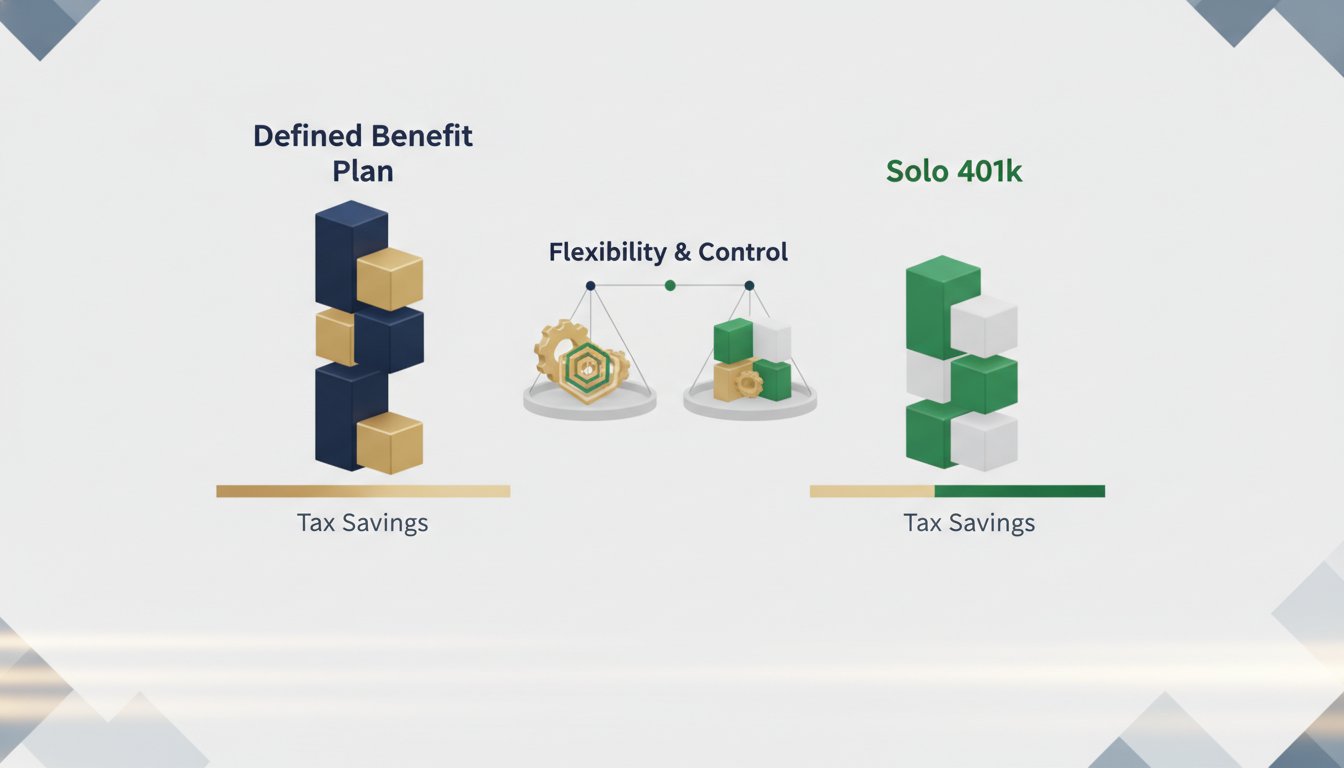
For high-earning freelancers, the choice between a defined benefit plan vs solo 401k freelancer retirement strategy can mean a difference of tens of thousands of dollars in annual tax deductions. A defined benefit plan is a traditional pension plan for self-employed individuals that uses actuarial formulas to determine annual contributions, while a Solo 401k is a defined contribution plan with fixed annual limits set by the IRS. Understanding which plan delivers larger tax savings at your income level is essential for maximizing your retirement contributions and reducing your self-employment tax burden.
The Solo 401k remains the most popular self-employed retirement plan for good reason — it is simple to set up, offers high contribution limits, and provides flexibility. For 2025, the maximum Solo 401k contribution is $69,000, rising to $76,500 for those age 50 or older who can make catch-up contributions.1 These limits combine two components: employee salary deferrals and employer profit-sharing contributions.
The employee deferral portion allows you to contribute up to $23,500 in 2025 as the "employee" of your own business.2 The employer profit-sharing contribution can add up to 25% of your net self-employment income, bringing the total to the $69,000 cap.2 For 2026, the IRS has increased the Solo 401k contribution limit to $70,000 for those under 50, with the catch-up provision increasing to $7,500 for age 50 and older.1
Consider a hypothetical freelance consultant earning $200,000 in net self-employment income. Under the Solo 401k rules, they could contribute $23,500 as an employee deferral plus up to 25% of their net income as an employer profit-sharing contribution, reaching the combined maximum of $69,000 for 2025.1 This deduction directly reduces their adjusted gross income (AGI) and, consequently, their self-employment tax liability.
Defined Benefit Plan vs Solo 401k: Which Saves More in Taxes
When comparing a defined benefit plan vs solo 401k freelancer tax savings, the defined benefit plan almost always wins for high earners — but with trade-offs. A defined benefit plan allows contributions based on the annual benefit you want to receive at retirement, calculated by an actuary using your age and current income. For a freelancer earning $250,000 at age 45, a defined benefit plan might allow deductible contributions of $150,000 or more per year, far exceeding the Solo 401k's $69,000 cap.
The tax savings difference is substantial. At a 32% federal marginal tax rate, a $69,000 Solo 401k contribution saves approximately $22,080 in federal income tax. A $150,000 defined benefit plan contribution at the same rate saves $48,000. Add in self-employment tax savings — the 15.3% combined Social Security and Medicare tax on Schedule C income — and the defined benefit plan reduces your total tax bill by roughly $22,950 more per year.2
However, the Solo 401k offers simplicity. No actuarial certification, no annual Form 5500-EZ filing until assets exceed $250,000, and no mandatory minimum funding requirements.3 The defined benefit plan requires annual actuarial certification and carries penalties for underfunding.
How a Defined Benefit Plan Works for High-Earning Freelancers
A defined benefit plan for self-employed individuals functions like a traditional corporate pension. You establish a target annual retirement benefit — for example, $100,000 per year starting at age 65 — and an actuary calculates how much you must contribute each year to fund that benefit. The contribution is fully tax-deductible as a business expense.
The IRS allows defined benefit plans for sole proprietors, single-member LLCs, and S corporations with no common-law employees.4 The contribution limit depends on your age and income. A 50-year-old freelancer earning $300,000 might contribute $200,000 or more annually, while a 35-year-old with the same income might be limited to $80,000 because they have more years to fund the benefit.
Suppose a 48-year-old freelance software architect earning $350,000 wants to retire at 65 with $120,000 per year. An actuary calculates that funding this benefit requires annual contributions of approximately $175,000.5 This deduction reduces their AGI from $350,000 to $175,000, cutting their federal income tax by roughly $56,000 at the 32% bracket and saving approximately $26,775 in self-employment tax.2
Solo 401k Contribution Limits and Profit-Sharing Mechanics
The Solo 401k profit-sharing component is where the math gets nuanced for high earners. The employer contribution is limited to 25% of your net self-employment income, defined as Schedule C net profit minus half your self-employment tax. For example, suppose a freelancer has $200,000 in Schedule C net profit. The calculation works as follows: net profit of $200,000 minus $14,130 (half of self-employment tax)2 equals $185,870 in net earnings from self-employment. Twenty-five percent of $185,870 is $46,468, which becomes the maximum employer contribution.3
Combined with the $23,500 employee deferral, the total Solo 401k contribution reaches $69,968 — but the IRS caps the total at $69,000 for 2025, so the employer contribution must be reduced to $45,500.1 This cap creates the ceiling that high earners hit quickly. For example, at $150,000 in net profit, the maximum Solo 401k contribution is approximately $60,000. At $250,000, it remains $69,000.
The Solo 401k also requires Form 5500-EZ annual filing once plan assets exceed $250,000. In 2023, over 222,848 Form 5500 filings were submitted, reflecting the growing number of freelancers who have accumulated significant retirement savings.3
Comparing Tax Deductions: Defined Benefit Plan vs Solo 401k
| Feature | Solo 401k | Defined Benefit Plan |
|---|---|---|
| Maximum annual contribution (age 45, $250K income) | $69,000 | $150,000+ |
| Federal income tax savings at 32% bracket | $22,080 | $48,000+ |
| Self-employment tax savings | ~$10,557 | ~$22,950+ |
| Annual filing requirement | Form 5500-EZ if assets > $250K | Form 5500-EZ + actuarial certification |
| Setup complexity | Low (adoption agreement) | High (actuarial document) |
| Funding flexibility | Flexible (skip years) | Mandatory minimum funding |
The table above illustrates the core trade-off. For example, a defined benefit plan vs solo 401k freelancer comparison at $250,000 income shows the defined benefit plan delivering roughly $38,313 more in total tax savings annually1. However, the Solo 401k requires no actuarial work and allows you to skip contributions in lean years.
For a freelancer earning $180,000, the Solo 401k maximum contribution is approximately $63,0001, saving roughly $20,160 in federal tax and $9,639 in self-employment tax2. A defined benefit plan at the same income might allow $90,000 in contributions, saving $28,800 in federal tax and $13,770 in self-employment tax — a $12,771 annual difference.
When a Defined Benefit Plan Makes Sense for Your Freelance Income
A defined benefit plan becomes attractive when your net self-employment income consistently exceeds a high threshold — for example, $200,000 — and you are age 40 or older. The combination of higher income and fewer years until retirement allows larger actuarially calculated contributions. Freelancers in their 50s can often contribute $200,000 or more annually1, making the defined benefit plan the most powerful tax deduction available.
The plan also makes sense if you have irregular income but consistently high earnings. Suppose a freelance management consultant earns $400,000 one year and $250,000 the next. A defined benefit plan can be designed with variable contribution formulas that adjust to your income, though this requires actuarial documentation and IRS-approved plan provisions. Minimum funding requirements still apply, and missing a required contribution triggers IRS penalties and potential plan disqualification.
Schedule C sole proprietors face IRS audit rates of approximately 1.1% to 1.3%, depending on income level.5 Large retirement plan contributions may reduce your reported net profit, which could lower audit risk by reducing your Schedule C appearance. For example, a defined benefit plan contribution of $150,000 on $300,000 of income cuts your Schedule C net profit in half, making your return less likely to trigger IRS scrutiny.
Solo 401k Flexibility: Why Some Freelancers Choose It Over a Pension Plan
The Solo 401k's flexibility is its strongest advantage. You can contribute as an employee one year and skip entirely the next. You can take loans from the plan — up to $50,000 or 50% of your vested balance, per IRS rules1 — without triggering a taxable distribution. You can roll over funds from previous employer 401k plans, IRAs, and SEP IRAs into the Solo 401k, consolidating retirement accounts.
For freelancers under age 40 with incomes in the mid-to-high six figures, the Solo 401k often makes more sense than a defined benefit plan. The contribution gap is smaller at lower incomes — for example, roughly $50,000 for a Solo 401k versus $65,000 for a defined benefit plan — and the administrative costs of the defined benefit plan (typically $1,500 to $3,000 annually for actuarial services) eat into the tax savings.
For freelancers who expect higher tax rates in the future, the Solo 401k provides valuable tax diversification through the employee deferral. You pay taxes now on contributions and withdraw tax-free in retirement, hedging against potential rate increases.
Combining Both Plans: The Ultimate Tax Strategy for 1099 Earners
High-earning freelancers can combine a Solo 401k and a defined benefit plan in the same tax year. The Solo 401k employee deferral of $23,500 remains available1, and the defined benefit plan contribution is calculated independently. The combined contributions can exceed $200,000 annually for older, high-income freelancers2.
Consider a hypothetical 52-year-old freelance marketing director earning $400,000. They contribute $23,500 as a Solo 401k employee deferral and, for example, $31,000 as a Solo 401k employer profit-sharing contribution (roughly 25% of approximately $124,000 in net earnings after the defined benefit plan deduction). Their defined benefit plan contribution is, say, $180,000. Total retirement contributions in this scenario: $234,500. Total tax savings at a 35% federal rate: approximately $82,075 in federal income tax plus $35,879 in self-employment tax.
This strategy requires careful coordination. The defined benefit plan contribution reduces your net earnings from self-employment, which in turn reduces the Solo 401k employer contribution calculation. An actuary must certify both plans are properly funded. The combined annual filing includes Form 5500-EZ for each plan.
Your Next Step
Run a side-by-side contribution projection for your specific income level and age. Use the IRS retirement plan contribution calculator or consult a fee-only actuary who specializes in one-participant defined benefit plans. Compare the Solo 401k maximum of $70,000 (2026) against the defined benefit plan projection for your age and income. If the defined benefit plan allows contributions exceeding $100,000 annually4, the tax savings likely justify the administrative costs. For freelancers under 40 with incomes below $200,0004, the Solo 401k remains the simpler, more cost-effective choice.
Footnotes
-
https://www.irs.gov/newsroom/401k-limit-increases-to-23500-in-2026-contribution-limits-for-solo-401k-drops ↩ ↩2 ↩3 ↩4 ↩5 ↩6 ↩7 ↩8 ↩9 ↩10 ↩11 ↩12
-
https://www.ssa.gov/newsrels/pressreleases/2024/annual-fact-sheet.html ↩ ↩2 ↩3 ↩4 ↩5 ↩6 ↩7 ↩8
-
https://www.dol.gov/agencies/ebsa/about-ebsa/our-activities/publication/disclosure-form-5500 ↩ ↩2 ↩3 ↩4
-
https://www.irs.gov/retirement-plans/retirement-plans-for-self-employed-individuals ↩ ↩2 ↩3 ↩4