When the Simplified Method Wins (and When It Loses)
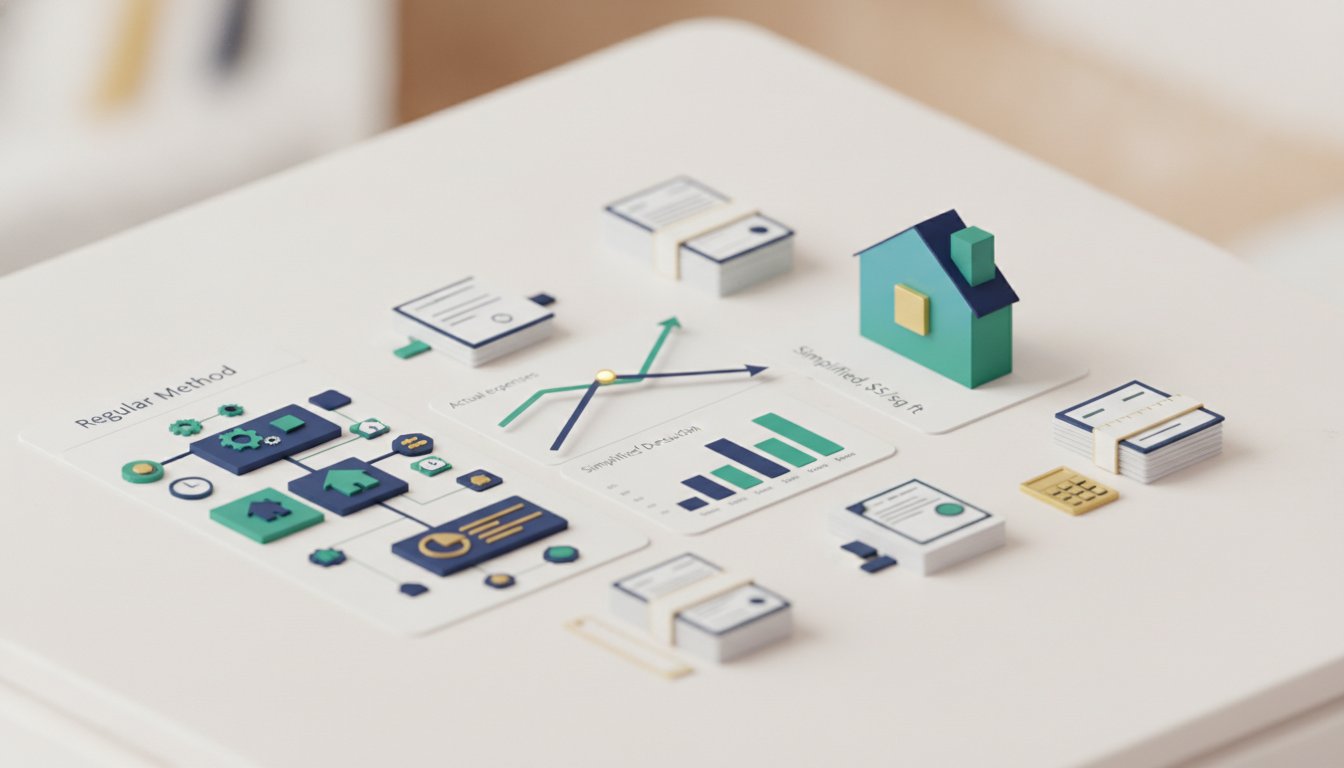
A home office deduction calculator is a tool that compares the simplified method ($5 per square foot, up to $1,500) against the regular method (actual expenses multiplied by business use percentage) to determine which approach yields the larger deduction for a self-employed taxpayer. It answers one specific question: which method produces the larger deduction for your situation.
The simplified method wins for freelancers with low housing costs relative to their home office square footage. Consider a hypothetical 1099 graphic designer renting a one-bedroom apartment for $1,200 per month with a 100-square-foot home office in a 900-square-foot apartment. The simplified method yields $500 (100 sq ft × $5 per sq ft)1. The regular method would calculate roughly 11.1% of $14,400 in annual rent — approximately $1,600 — plus a share of utilities2. In this scenario, the regular method wins decisively.
The simplified method wins when the home office is small and housing costs are modest. For a freelancer using a 50-square-foot desk area in a low-cost city apartment renting for $900 per month, the simplified method gives $2501. The regular method would yield roughly $60 (approximately 5.5% of $10,800 annual rent) plus a small utility share — less than $2502. The simplified method also wins when the freelancer has minimal deductible housing expenses, such as a paid-off home with low property taxes and no mortgage interest.
The simplified method loses in high-cost housing markets. Suppose a 1099 consultant uses 200 square feet of a 2,000-square-foot home in San Francisco with $4,500 monthly rent. The simplified method caps at $1,000 (200 sq ft × $5 per sq ft)1. The regular method calculates 10% of $54,000 annual rent — $5,400 — plus utilities and insurance2. The regular method produces over five times the deduction.
The simplified method also loses when the home office occupies a large percentage of the home. Suppose a freelancer uses 300 square feet of a 1,200-square-foot condo — 25% business use — with $2,000 monthly rent. The simplified method caps at $1,500 (the maximum). The regular method would yield $6,000 (25% of $24,000 annual rent) plus utilities — four times the simplified deduction1.
The Home Office Deduction Calculator: What It Actually Does
A home office deduction calculator compares two IRS-approved methods side by side using the same inputs: home office square footage, total home square footage, and annual housing expenses. The calculator applies the business use percentage formula — dividing home office square footage by total home square footage — to the regular method, then compares that result against the simplified method's $5 per square foot calculation2.
A typical calculator output shows three numbers: the simplified method deduction, the regular method deduction, and the difference.
| Home Office (sq ft) | Total Home (sq ft) | Annual Housing Costs (Illustrative) | Simplified Method | Regular Method | Difference |
|---|---|---|---|---|---|
| 100 | 900 | $14,400 | $500 | ~$1,600 | Regular wins by ~$1,100 |
| 200 | 2,000 | $54,000 | $1,000 | ~$5,400+ | Regular wins by ~$4,400 |
| 300 | 1,200 | $24,000 | $1,500 (capped) | ~$6,000 | Regular wins by ~$4,500 |
These annual housing cost figures are illustrative examples used to demonstrate the calculation difference between methods. Actual housing costs vary based on rent, mortgage, utilities, and other expenses specific to each taxpayer's situation.
For a hypothetical freelancer with 150 square feet in a 1,500-square-foot home paying $18,000 annual rent and $3,600 in utilities, the calculator would show $750 (simplified) versus $2,160 (regular) — a $1,410 advantage for the regular method.
The calculator also flags when the simplified method's $1,500 cap applies. If the home office exceeds 300 square feet, the simplified method maxes out at $1,500 regardless of actual expenses. The regular method has no cap — it scales with actual housing costs1.
The home office must still meet the regular and exclusive use test — the space must be used regularly and exclusively for business3.
Simplified Method: The $5 Per Square Foot Shortcut
The simplified method allows a deduction of $5 per square foot of home office space, up to 300 square feet, for a maximum deduction of $1,500 per year1. This method requires no calculation of actual housing expenses, no depreciation tracking, and no receipts for home-related costs. The freelancer simply measures the office space, multiplies by $5, and enters the result on Schedule C.
The trade-off is simplicity for potential deduction size. The simplified method ignores actual housing costs entirely. A freelancer paying $3,000 per month in rent gets the same $5 per square foot rate as one paying $900 per month. The method does not account for mortgage interest, property taxes, utilities, insurance, or repairs — all of which are deductible under the regular method.
Record-keeping under the simplified method is minimal. The freelancer needs only a floor plan or measurement showing the office square footage and a note confirming regular and exclusive business use. No utility bills, no mortgage statements, no depreciation schedules4.
The simplified method is ideal for freelancers who rent in low-cost areas, have small home offices, or want to avoid the complexity of Form 8829. It is also useful for freelancers who started using a home office mid-year or moved during the tax year, since the square footage calculation is straightforward.
Regular Method: Tracking Actual Expenses for Maximum Deduction
The regular method calculates the home office deduction by multiplying actual housing expenses by the business use percentage. The business use percentage equals home office square footage divided by total home square footage2. Direct expenses — repairs or painting specific to the home office — are deducted in full. Indirect expenses — rent, mortgage interest, property taxes, utilities, homeowners insurance, and maintenance — are deducted at the business use percentage.
Depreciation must be calculated separately under the regular method using IRS Form 88291. The home's basis (excluding land value) is depreciated over 39 years for a home office, and the annual depreciation amount is multiplied by the business use percentage. This adds complexity but also adds a significant deduction for homeowners.
The regular method requires detailed record-keeping. The freelancer must retain all housing expense receipts, utility bills, property tax statements, and mortgage interest statements. A floor plan or measurement documenting the office square footage is also required. If the IRS audits the deduction, the freelancer must produce these records.
The regular method produces a larger deduction in most cases where housing costs are moderate to high. For a hypothetical freelancer with 200 square feet in a 1,800-square-foot home paying $24,000 annual rent and $4,800 in utilities, the regular method yields $3,200 (11.1% of $28,800) versus $1,000 simplified — a $2,200 advantage.
The depreciation recapture trap is the main downside. When the home is sold, depreciation claimed after May 6, 1997 is taxed at a 25% rate1, regardless of the homeowner's tax bracket. This applies even if the freelancer used the regular method and claimed depreciation. The simplified method avoids depreciation entirely, so no recapture applies.
Which Method Saves You More on Self-Employment Tax
The home office deduction reduces net profit on Schedule C, which directly lowers self-employment tax. Both methods reduce self-employment tax equally per dollar of deduction — the question is which method produces more deduction dollars.
Self-employment tax is 15.3% on the first $176,100 of net earnings (2025 rate)1 and 2.9% on earnings above that threshold. Every dollar of home office deduction saves 15.3 cents in self-employment tax for most freelancers, plus income tax savings at their marginal rate.
Consider a hypothetical 1099 software developer earning $120,000 with a 200-square-foot home office in a 2,000-square-foot home paying $30,000 annual rent and $5,000 in utilities. The simplified method gives $1,500 (200 sq ft × $5 per sq ft). The regular method gives $3,500 (10% of $35,000 in allocable expenses). The regular method saves an additional $382.50 in self-employment tax (15.3% of a $2,500 deduction difference) plus income tax savings.
For a freelancer near the Social Security wage base, the math shifts. If net earnings exceed the Social Security wage base ($176,100 in 2024), the self-employment tax savings on additional deductions drops to 2.9% (Medicare only). The regular method still wins on deduction size, but the marginal tax savings per dollar are lower.
The simplified method's $1,500 cap means it rarely wins on self-employment tax savings alone. The regular method almost always produces a larger deduction for freelancers with meaningful housing costs. The exception is a freelancer with very low housing costs — living rent-free in a family home with minimal utilities — where the simplified method's $5 per square foot may exceed actual allocable expenses.
Common Mistakes That Trigger an IRS Audit on Home Office Claims
The most common audit trigger is claiming a home office deduction without meeting the regular and exclusive use test. The space must be used regularly and exclusively for business — not occasionally for business and regularly for personal activities. A desk in the corner of a living room used for both work and watching television does not qualify3.
Claiming a home office deduction on a home that is also claimed as a rental property is another red flag. The IRS cross-references Schedule E (rental income) with Form 8829. If the same square footage is claimed as both a rental expense and a home office deduction, the return is flagged for review.
Using the regular method and failing to file Form 8829 is a common error. The regular method requires Form 8829 to calculate depreciation and allocate expenses. Filing only Schedule C with a handwritten home office deduction amount invites an audit.
Claiming full business use of the home — for example, 100% — is a near-certain audit trigger. Unless the home is used exclusively as a business premises with no personal living space, a claim of complete business use is almost always incorrect. The IRS knows that most freelancers use their homes for both business and personal purposes.
Depreciation errors under the regular method are another common issue. Some freelancers forget to include depreciation, leaving money on the table. Others claim depreciation on land value, which is not depreciable. The correct approach is to depreciate the building basis (purchase price minus land value) over 39 years.
How to Use the Calculator Before Filing Schedule C
Using a home office deduction calculator before filing Schedule C requires three inputs: home office square footage, total home square footage, and annual housing expenses. Measure the home office carefully — include only space used regularly and exclusively for business. Measure total home square footage from the exterior walls or use the square footage listed on the property tax assessment.
Annual housing expenses depend on whether the freelancer rents or owns. Renters include annual rent and utilities (electricity, gas, water, trash, internet). Homeowners include mortgage interest, property taxes, homeowners insurance, utilities, repairs, and depreciation. Exclude principal payments on the mortgage and improvements that increase the home's value.
Enter these numbers into the calculator. The output shows the simplified method deduction, the regular method deduction, and the difference. If the regular method wins by $2,000 or more1, use the regular method and file Form 8829. If the simplified method wins or the difference is under $2001, claim the simplified deduction for its simplicity.
Run the calculator again if housing costs change significantly during the year. A rent increase, a move to a new home, or a change in utility costs can shift which method is optimal. The calculation takes five minutes to update.
Your Next Step
Open a spreadsheet or use PreFileCheck's home office deduction calculator. Measure your home office square footage, find your total home square footage, and total your annual housing expenses. Run both methods. If the regular method wins by more than $2001, gather your receipts and prepare Form 8829. If the simplified method wins or the difference is small, claim the simplified deduction on Schedule C and keep your floor plan with your tax records. Either way, you have a documented, defensible deduction.
Footnotes
-
https://www.irs.gov/businesses/small-businesses-self-employed/simplified-option-for-home-office-deduction ↩ ↩2 ↩3 ↩4 ↩5 ↩6 ↩7 ↩8 ↩9 ↩10 ↩11 ↩12 ↩13 ↩14
-
https://blog.taxact.com/guide-to-home-office-deduction ↩ ↩2 ↩3 ↩4 ↩5
-
https://www.harpercpaplus.com/can-you-deduct-your-home-office-heres-what-you-need-to-know-for-2025 ↩ ↩2