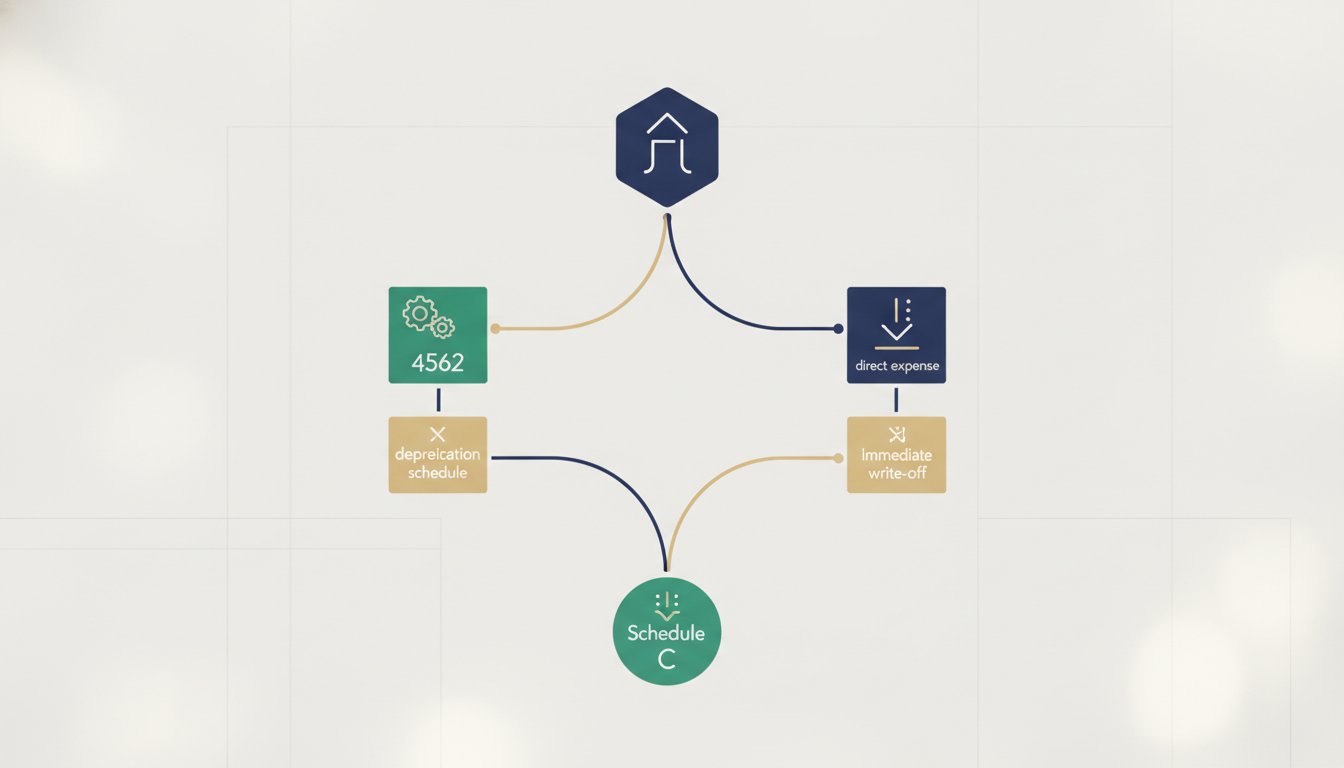
When does Schedule C require Form 4562? Form 4562 is the IRS form used to claim depreciation and amortization on business assets placed in service during the tax year. Filing a Schedule C for your freelance business seems straightforward until you buy a piece of equipment and the tax software asks if you need Form 4562. That single question determines whether you write off the full cost this year or spread it out over several years. The answer depends on what you bought, how much it cost, and which IRS election you make.
What Triggers Form 4562 on Schedule C vs Direct Expense
When does Schedule C require Form 4562? Filing a Schedule C for your freelance business seems straightforward until you buy a piece of equipment and the tax software asks if you need Form 4562. That single question determines whether you write off the full cost this year or spread it out over several years. The answer depends on what you bought, how much it cost, and which IRS election you make.
Form 4562 is the IRS form used to claim depreciation and amortization. For Schedule C filers, the trigger is simple: you must file Form 4562 if you are claiming depreciation on any business asset placed in service during the tax year that you did not fully expense under Section 179 or the de minimis safe harbor.1
A direct expense, by contrast, means you deduct the full cost of an item in the year you bought it. The IRS allows this for supplies and for tangible property that qualifies under the de minimis safe harbor rule. No Form 4562 is needed for direct expenses.
The key distinction is whether the asset has a useful life beyond one year. A laptop, camera, printer, or office furniture typically lasts multiple years. The IRS considers these capital assets. If you want to deduct them, you either use Section 179 to expense them immediately (which requires Form 4562) or depreciate them over their useful life (which also requires Form 4562). The only exception is the de minimis safe harbor, which lets you treat items under a certain threshold as supplies.
When Schedule C Requires Form 4562 for Asset Depreciation
Schedule C requires Form 4562 whenever you place a depreciable asset in service during the tax year and choose to depreciate it rather than expense it under Section 179.1 This applies to any tangible property used in your business with a determinable useful life of more than one year.
Consider a hypothetical freelance videographer who buys a $4,000 camera body and a $1,200 lens in 2025. If she chooses to depreciate the camera over five years using MACRS (Modified Accelerated Cost Recovery System), she must file Form 4562. The form calculates the depreciation deduction using the correct recovery period, convention, and method.
Form 4562 is also required when claiming depreciation on listed property — assets like computers, vehicles, and entertainment equipment that the IRS considers prone to personal use.2 If business use of listed property falls below 50%, the IRS requires additional documentation and limits the depreciation method.3
The form itself has multiple parts. Part I handles Section 179 expensing. Part II handles MACRS depreciation. Part III handles listed property. Part V handles amortization. Schedule C filers typically only need Parts I and II, but the entire form must be attached to the return.
Direct Expense vs Capitalize: The $2,500 Safe Harbor Rule
The de minimis safe harbor under IRS Revenue Procedure 2024-1 allows taxpayers to expense tangible property costing $2,500 or less per item (or invoice) without treating it as a capital asset.4 For taxpayers with applicable financial statements, the threshold rises to $5,000 per item.
This rule is the most practical tool freelancers have to avoid Form 4562. If you buy a $200 monitor, a $150 printer, or a $400 standing desk converter, you can deduct the full cost as a direct expense on Schedule C, line 22 (Supplies). No Form 4562 required.
The table below summarizes the three paths for handling business equipment:
| Asset Cost | Method | Form 4562 Required? | Deduction Timing |
|---|---|---|---|
| Under $2,500 | De minimis safe harbor | No | Full deduction in year of purchase |
| $2,500 to $1,170,000 | Section 179 | Yes | Full deduction in year of purchase |
| Any amount | MACRS depreciation | Yes | Spread over 3-7 years |
The de minimis safe harbor is an annual election. You must attach a statement to your tax return the first year you use it, but after that, you simply apply it consistently.4 Freelancers who buy multiple small items each year should use this election to avoid unnecessary paperwork.
How to Identify Assets That Trigger Form 4562
Identifying which assets trigger Form 4562 requires answering three questions about each purchase:
- Does the asset have a useful life of more than one year?
- Does the asset cost more than $2,500 per item?
- Do you want to deduct the full cost this year using Section 179?
If the answer to question 1 is yes and the answer to question 2 is yes, you must file Form 4562 regardless of whether you use Section 179 or MACRS depreciation. If the answer to question 1 is yes and the answer to question 2 is no, you can use the de minimis safe harbor and skip Form 4562.
For a typical freelancer, the assets that most commonly trigger Form 4562 include:
- Computers and laptops over $2,500
- Cameras and video equipment over $2,500
- Furniture and fixtures over $2,500
- Machinery and tools over $2,500
- Vehicles used for business
Suppose a freelance graphic designer buys a $3,200 laptop in 2025 — for example, a high-end model for video editing. That laptop has a useful life of five years and costs more than $2,500. She must file Form 4562. She can either expense the full amount under Section 179 (Part I of Form 4562) or depreciate it over five years using MACRS (Part II of Form 4562).
Section 179 Deduction Limits for Freelancers in 2025
Section 179 allows freelancers to deduct the full cost of qualifying property in the year it is placed in service, rather than depreciating it over multiple years. For 2025, the maximum Section 179 deduction is $1,170,000.5 The deduction begins to phase out dollar-for-dollar when total qualifying property placed in service exceeds $2,890,000.
For most freelancers, these limits are irrelevant. A solo consultant buying, for example, $10,000 in equipment will never approach the phase-out threshold. The practical limit is that Section 179 cannot create or increase a net loss from the business. The deduction is limited to the taxable income from the business.
Section 179 applies to tangible personal property used in the business — computers, office furniture, machinery, equipment, and certain improvements to nonresidential real property. It does not apply to land, buildings, or property used outside the United States.
A hypothetical freelance photographer earning $80,000 in net profit who buys $15,000 in camera equipment can deduct the full $15,000 under Section 179, reducing taxable income to $65,000. She must file Form 4562 to claim this deduction.
Bonus Depreciation Rules for Self-Employed Tax Filers
Bonus depreciation allows an additional first-year depreciation deduction on qualifying property. For 2024, bonus depreciation is 40% of the asset's cost.6 For 2025, it drops to 20%. After 2026, bonus depreciation is scheduled to phase out entirely unless Congress extends it.
Bonus depreciation applies to property with a recovery period of 20 years or less, including computers, equipment, furniture, and certain improvements. Unlike Section 179, bonus depreciation has no dollar cap and no taxable income limitation. It can create a net operating loss.
For Schedule C filers, bonus depreciation is claimed on Form 4562, Part II. The form calculates the bonus depreciation percentage and applies it to the asset's basis before regular MACRS depreciation.
Consider a hypothetical freelance videographer who buys a $20,000 camera rig in 2025. Under Section 179, she could expense up to $20,0001, but only if she has sufficient business income. Under bonus depreciation, she could deduct 20% ($4,000)2 in the first year plus regular MACRS depreciation on the remaining $16,0002. The total first-year deduction would be approximately $6,8002, depending on the asset class and convention.
Common Schedule C Asset Mistakes That Trigger IRS Audits
The most common mistake freelancers make is treating large equipment purchases as supplies. A $5,000 camera system deducted on Schedule C line 22 as "supplies" is a red flag. The IRS expects capital assets to be capitalized and depreciated or expensed under Section 179 with Form 4562 attached.
Another frequent error is failing to file Form 4562 when required. If a freelancer buys a $3,000 laptop and deducts it as a direct expense without using the de minimis safe harbor or Section 179, the IRS may disallow the deduction entirely. The IRS can also impose accuracy-related penalties for substantial understatement of tax.
Listed property rules trip up many freelancers. Computers and vehicles are listed property. If business use drops below 50% in any year, the IRS requires recapture of excess depreciation.3 Freelancers who use a laptop for both business and personal purposes must track business use percentage and report it on Form 4562, Part III.
A third mistake is claiming Section 179 on property that does not qualify. Section 179 does not apply to property used for lodging, property used outside the US, or property acquired from a related party. Freelancers who buy a rental property couch and try to Section 179 it will face IRS scrutiny.
What to Do When You Miss the Form 4562 Filing Deadline
Missing the Form 4562 deadline is not the end of the world, but it requires corrective action. If you filed your Schedule C without Form 4562 and should have included it, you need to file an amended return using Form 1040-X.
The IRS allows you to file Form 4562 with an amended return as long as the original return was filed on time. If you missed the deadline entirely, you can still file Form 4562 with a late return, but you may owe penalties and interest on any additional tax due.
For Section 179 elections, the deadline to make or revoke the election is the due date of the return (including extensions). If you missed that deadline, you cannot retroactively elect Section 179 on an amended return. You must use MACRS depreciation instead.
A practical tip: if you realize the error within three years of the original filing date, file Form 1040-X with the corrected Form 4562 attached. The IRS will process the amendment and adjust your tax liability accordingly.
Your Next Step
Review every equipment purchase you made this year that cost more than $500. For each item, determine whether it qualifies for the de minimis safe harbor (under $2,500) or requires Form 4562. If you have assets over $2,500, download Form 4562 from the IRS website and familiarize yourself with Part I (Section 179) and Part II (MACRS depreciation). PreFileCheck's asset classification tool can help you categorize each purchase and determine whether Form 4562 is required — use it before you file to avoid missing the deadline.