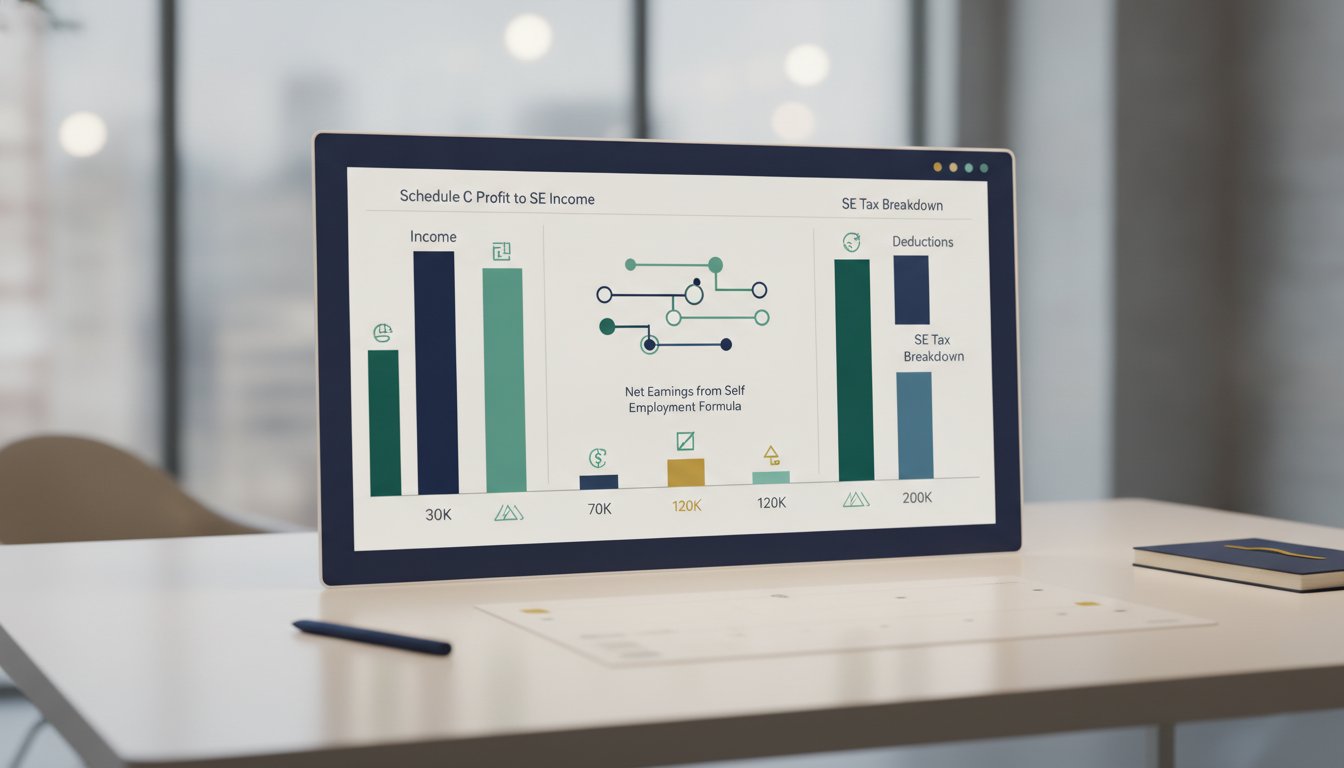
Understanding the 92.35% Net Earnings Adjustment
The self-employment tax calculation formula is the IRS method for determining how much of your freelance income is subject to Social Security and Medicare taxes. It starts with your Schedule C net profit, applies a 92.35% adjustment, and then multiplies the result by the 15.3% SE tax rate to arrive at your total self-employment tax liability.
The 92.35% adjustment is the most misunderstood step in the self-employment tax calculation formula. The IRS assumes that the employer-equivalent portion of your SE tax (7.65%) is a business expense, so they exclude it from the taxable base before applying the 15.3% rate.1
Consider a hypothetical freelance graphic designer with $75,000 in Schedule C net profit. Many freelancers assume the full amount is subject to SE tax. In reality, the IRS multiplies that figure by 92.35%, yielding roughly $69,263 in net earnings from self-employment.2 The difference — about $5,737 — represents the employer-equivalent tax deduction built into the formula.
The math works the same way at every income level. For a 1099 contractor earning $150,000, for example, the adjustment reduces the taxable base to $138,525. The adjustment is not optional — it is a mandatory step in the IRS worksheet, not an election you make.
What Counts as Self-Employment Income on Schedule C
Schedule C net profit is the starting point, but not every dollar flowing through your business counts as self-employment income. The IRS defines self-employment income as net earnings from a trade or business where you are not an employee.2
Income sources that qualify include payments received on Form 1099-NEC for services performed, cash payments from clients who do not issue 1099s, fees, commissions, and honoraria for personal services, and income from a sole proprietorship or single-member LLC.
Income that does not count includes W-2 wages from an employer (already subject to FICA), rental income from real estate (unless you are a real estate professional), capital gains and investment dividends, and interest income from savings accounts.
For a hypothetical freelance writer earning $50,000 in 1099-NEC payments and $5,000 in bank interest, only the $50,000 appears on Schedule C and flows into the SE tax calculation. The interest is reported separately on Schedule B and is not subject to self-employment tax.
The Self-Employment Tax Calculation Formula Step by Step
The IRS self-employment tax calculation formula follows four sequential steps. Using a $75,000 net profit example:
| Step | Calculation | Amount |
|---|---|---|
| 1. Schedule C net profit | Starting figure | $75,000 |
| 2. Multiply by 92.35% | $75,000 × 0.9235 | $69,263 |
| 3. Apply 15.3% SE tax rate | $69,263 × 0.153 | $10,597 |
| 4. Deduct 50% of SE tax | $10,597 × 0.50 | $5,299 |
The $10,597 is your total SE tax, reported on Schedule SE and transferred to Schedule 2 of Form 1040. The $5,299 deduction is taken on Schedule 1, reducing your adjusted gross income.3
For a $150,000 net profit scenario:
| Step | Calculation | Amount |
|---|---|---|
| 1. Schedule C net profit | Starting figure | $150,000 |
| 2. Multiply by 92.35% | $150,000 × 0.9235 | $138,525 |
| 3. Social Security portion (12.4%) | $138,525 × 0.124 | $17,177 |
| 4. Medicare portion (2.9%) | $138,525 × 0.029 | $4,017 |
| 5. Total SE tax | $17,177 + $4,017 | $21,194 |
| 6. Deduct 50% of SE tax | $21,194 × 0.50 | $10,597 |
The Social Security wage base for 2025 is $176,100.4 For a freelancer earning $200,000 in net profit, the 92.35% adjustment brings net earnings to $184,700. The Social Security portion applies only to the first $176,100, so the calculation splits: $176,100 × 12.4% = $21,836 for Social Security, plus $184,700 × 2.9% = $5,356 for Medicare, totaling $27,192 in SE tax.5
How to Reduce SE Tax with the QBI Deduction
The Qualified Business Income deduction under 26 U.S.C. § 199A does not directly reduce your SE tax, but it lowers your overall tax burden on the same Schedule C profit. For a freelancer earning $75,000, the QBI deduction allows you to exclude up to 20% of qualified business income from federal income tax.5
For a hypothetical freelance consultant earning $150,000, the QBI deduction phases out once taxable income exceeds $191,950 for single filers in 2024.1 Specified service trades or businesses — including health, law, consulting, and financial services — face full phase-out at $241,950.1 A consultant earning above the phase-out threshold would receive a reduced QBI deduction or none at all, depending on their total taxable income.
Quarterly Estimated Tax Payments: When and How Much
The IRS requires estimated tax payments when you expect to owe at least $1,000 in tax after withholding and credits.6 For a freelancer with no W-2 job, that means every dollar of SE tax and income tax must be paid quarterly.
The four payment deadlines are April 15, June 15, September 15, and January 15 of the following year. Each payment covers one quarter of your estimated annual tax liability. For a freelancer earning $75,000, total tax might include $10,597 in SE tax plus approximately $8,000 in federal income tax, totaling $18,597. Each quarterly payment would be $4,649.7
The safe harbor rule protects you from underpayment penalties if you pay either 100% of the prior year's total tax liability or 90% of the current year's liability. If your AGI exceeded $150,000 in the prior year, the safe harbor threshold rises to 110%.8
Entity Structure Options: LLC vs S-Corp for SE Tax
A single-member LLC is taxed as a sole proprietorship by default — all net profit flows through to Schedule C and is subject to SE tax. An S-Corp election changes the structure: you pay yourself a reasonable salary (subject to FICA taxes) and take remaining profits as distributions, which are not subject to SE tax.7
The S-Corp election becomes tax-efficient when net earnings exceed approximately $40,000 annually. Consider a hypothetical freelance developer earning $100,000. As a sole proprietor, SE tax on that income — calculated on 92.35% of net earnings at the 15.3% self-employment tax rate9 — comes to roughly $14,130. As an S-Corp with a $50,000 salary, FICA taxes on the salary are $7,650, and the $50,000 distribution incurs no SE tax. Total savings amount to approximately $6,48010, minus additional payroll processing costs and Form 1120-S filing fees.
At higher net profit levels, the savings grow. A $100,000 salary triggers $15,300 in FICA taxes, while the remaining distribution avoids SE tax entirely. The savings of approximately $12,7801 must be weighed against the administrative burden of payroll, quarterly payroll tax filings, and state-level S-Corp requirements.
Tracking Deductions That Lower Your SE Taxable Income
Every dollar of deductible business expense reduces your Schedule C net profit, which directly lowers your SE tax. The most impactful deductions for freelancers include the home office deduction, health insurance premiums, and retirement plan contributions.
The home office deduction using the simplified method allows $5 per square foot up to 300 square feet, for a maximum of $1,500.7 The actual expense method can yield a larger deduction if your home office occupies a significant percentage of your home and you have high mortgage interest or rent costs.9
Health insurance premiums paid with after-tax dollars are deductible on Schedule 1, reducing AGI but not SE tax directly. SEP IRA contributions of up to 25% of net earnings (capped at $69,000 for 2024) reduce both income tax and SE tax because they lower Schedule C net profit.10
For a hypothetical freelancer earning $75,000, contributing $15,000 to a SEP IRA reduces Schedule C profit to $60,000. SE tax drops from $10,597 to $8,478, saving $2,119 in SE tax alone, plus the income tax savings on the $15,000 contribution.11
Avoiding the SE Tax Surprise at Filing Time
The most common SE tax surprise comes from underestimating the total tax rate. Freelancers often calculate only the 15.3% SE tax9 and forget that federal income tax adds another 10% to 37% on top depending on their bracket.10 A freelancer earning $75,000 faces an effective total tax rate of roughly 25% to 30% when combining SE tax and income tax.
The second surprise is the Social Security wage base cap. Freelancers earning over $176,100 often assume their SE tax drops significantly after hitting the cap. While the 12.4% Social Security portion stops, the 2.9% Medicare portion continues on all net earnings with no cap, plus an additional 0.9% Medicare surtax on earnings over $200,000 for single filers.11
Using PreFileCheck to run a mid-year tax projection prevents these surprises. Input your year-to-date Schedule C profit, estimated remaining income, and deductible expenses. The tool calculates your estimated SE tax and income tax, showing exactly what you need to set aside for quarterly payments.
Your Next Step
Run a mid-year tax projection using PreFileCheck before your next quarterly estimated tax deadline. Enter your year-to-date Schedule C income and expenses, then add your projected earnings for the remainder of the year. The tool will calculate your estimated SE tax, income tax, and QBI deduction, showing you exactly how much to pay by the next quarterly deadline. This single step eliminates the SE tax surprise and ensures you are setting aside the correct percentage of every client payment.
Footnotes
-
IRS Publication 535: Business Expenses. https://www.irs.gov/pub/irs-pdf/p535.pdf ↩ ↩2 ↩3 ↩4
-
IRS Publication 334: Tax Guide for Small Business. https://www.irs.gov/pub/irs-pdf/p334.pdf ↩ ↩2
-
IRS Schedule SE Instructions. https://www.irs.gov/pub/irs-pdf/i1040sse.pdf ↩
-
Social Security Administration: Cost-of-Living Adjustment Information. https://www.ssa.gov/newspress/factsheets/colafacts2025.html ↩ ↩2
-
IRS Publication 505: Tax Withholding and Estimated Tax. https://www.irs.gov/pub/irs-pdf/p505.pdf ↩ ↩2
-
IRS Publication 505: Estimated Tax Safe Harbor. https://www.irs.gov/publications/p505 ↩
-
IRS Publication 587: Business Use of Your Home. https://www.irs.gov/pub/irs-pdf/p587.pdf ↩ ↩2 ↩3
-
IRS Form 2210 Instructions. https://www.irs.gov/pub/irs-pdf/i2210.pdf ↩
-
IRS Publication 334: SEP-IRAs. https://www.irs.gov/retirement-plans/sep-retirement-plans ↩ ↩2 ↩3
-
IRS Publication 505: Self-Employment Tax. https://www.irs.gov/publications/p505 ↩ ↩2 ↩3
-
IRS Topic No. 557: Additional Medicare Tax. https://www.irs.gov/tax-professionals/topic-no-557-additional-medicare-tax ↩ ↩2