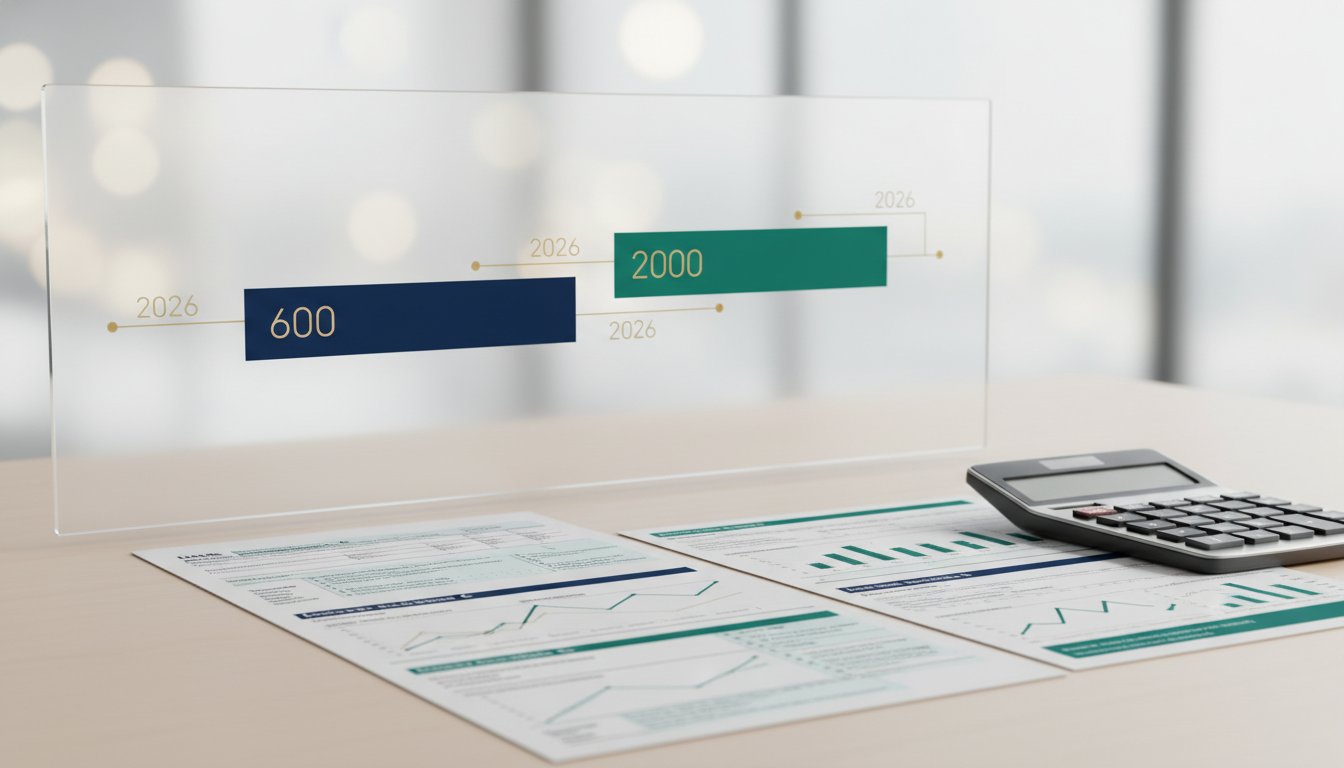
The 1099-NEC threshold 2026 is the minimum payment amount at which businesses must report nonemployee compensation on IRS Form 1099-NEC — a figure recently raised by the One Big Beautiful Bill Act (OBBBA) from $6001 to $2,0002. Under the new threshold, freelancers earning less than $2,000 from a single client won't receive a 1099-NEC form but must still report all income on Schedule C. Track every payment regardless of threshold to avoid IRS penalties.
What OBBBA Changed for 1099-NEC Reporting in 2026
The 1099-NEC threshold 2026 is the minimum payment amount at which businesses must report nonemployee compensation on IRS Form 1099-NEC — a figure recently raised by the One Big Beautiful Bill Act (OBBBA) from $6001 to $2,0002.
The OBBBA raises the 1099-NEC reporting threshold from $6001 to $2,0002 starting with payments made in 2026. The 1099-NEC threshold 2026 change means clients who pay you less than $2,000 will no longer send a 1099-NEC form, but your obligation to report that income on Schedule C remains unchanged. Understanding the 1099-NEC reporting threshold change 2026 is essential for accurate self-employment tax filing and avoiding IRS penalties.
The One Big Beautiful Bill Act increased the 1099-NEC filing threshold from $600 to $2,000 for payments made after December 31, 2025. This is the first significant adjustment to the threshold since it was set at $600 in 1954. Beginning in 2027, the threshold will be adjusted annually for inflation, meaning it will rise gradually each year.
The change applies to both Form 1099-NEC (nonemployee compensation) and certain 1099-MISC payments under the same threshold rules. For payments made in 2025, the old $600 threshold still applies, and Form 1099-NEC must be filed with the IRS by February 2, 2026.
| Reporting Year | Threshold | Form Required | Inflation Adjustment |
|---|---|---|---|
| 2025 (filed in 2026) | $600 | 1099-NEC | No |
| 2026 (filed in 2027) | $2,000 | 1099-NEC | No |
| 2027 onward | $2,000 + inflation | 1099-NEC | Yes |
Most states have not yet aligned their state-level reporting thresholds to the OBBBA-driven federal changes, creating a compliance gap for freelancers who work across state lines.
What the $2,000 1099-NEC Threshold Means for Your 2026 Tax Filing
The $2,000 1099-NEC threshold means that clients who pay you between $600 and $2,000 in 2026 will not issue a 1099-NEC form. This does not change your legal obligation to report all income on Schedule C for self-employment tax purposes.
Consider a hypothetical freelance graphic designer earning $80,000 annually from 15 different clients. Under the old $600 threshold, all 15 clients would issue 1099-NEC forms. Under the new $2,000 threshold, only clients paying $2,000 or more — say 8 of those 15 — will issue forms. The remaining 7 payments, totaling roughly $12,000 in this example, must still be reported manually.
The IRS will not receive a matching 1099-NEC for payments under $2,000, which shifts the burden of accurate recordkeeping entirely to you. Without a 1099-NEC in your tax folder, it is easier to forget a client payment when preparing your return.
How the Reporting Change Affects Your Schedule C and Self-Employment Tax
Your Schedule C calculation remains identical regardless of whether you receive a 1099-NEC. Self-employment tax applies to net earnings from self-employment of $400 or more, and the 1099-NEC threshold change does not alter this rule.
The practical difference is verification. When you receive a 1099-NEC, the IRS has a matching document to compare against your Schedule C income line. Without that matching form for payments under $2,000, the IRS relies entirely on your reported figures. Discrepancies between your bank deposits and reported income may trigger an IRS correspondence audit.
| Income Source | 1099-NEC Received? | Reported on Schedule C? | IRS Match Exists? |
|---|---|---|---|
| Client A: $3,500 | Yes | Yes | Yes |
| Client B: $1,200 | No | Yes | No |
| Client C: $800 | No | Yes | No |
For a freelancer earning $50,000 from 10 clients, suppose 4 clients pay under $2,000. Those 4 payments totaling, for example, $6,000 will have no IRS matching document — your bank records become the primary evidence of that income.
Which Freelancers Will See the Biggest Impact from the New Threshold
Freelancers with many small clients will feel the threshold change most acutely. For example, a freelance writer earning $60,000 from 30 different publications — each paying $2,000 or less — would receive zero 1099-NEC forms in 2026. Every dollar must be tracked manually.
Freelancers with fewer, larger clients see minimal impact. A consultant earning $150,000 from 3 clients paying $50,000 each will still receive 1099-NEC forms from all three. The threshold change does not affect their reporting workflow.
Gig workers on platforms like Upwork, Fiverr, or DoorDash face a mixed scenario. Platform payments are often aggregated — for example, if a platform pays you $5,000 total across 50 gigs, they will issue a single 1099-NEC for the full amount. But individual clients paying directly under $2,000 will not.
Part-time freelancers earning between $600 and $2,000 from a single client are the most vulnerable group. They may assume no 1099-NEC means no tax filing requirement, which is incorrect and can lead to IRS penalties for failure to file.
Why Your 1099-NEC May Disappear Even If Your Income Stays the Same
A client who paid you $1,800 in 2025 issued a 1099-NEC because the threshold was $600. The same client paying you $1,800 in 2026 will not issue a 1099-NEC because the threshold is now $2,000. Your income did not change, but the paperwork did.
This creates a psychological risk. Freelancers who rely on their 1099-NEC stack as a checklist for income reporting may miss payments that fall below the new threshold. The IRS will not send a reminder that a client paid you, say, a typical freelancer payment — that is your responsibility.
Clients also benefit from the threshold change. Businesses that pay multiple freelancers under $2,000 each save significant administrative costs on form preparation and filing. The OBBBA estimated this reduction in paperwork burden as a primary justification for the increase.
For freelancers, the disappearance of 1099-NEC forms from smaller clients means your personal income tracking system must be more robust than ever. A spreadsheet updated quarterly is no longer optional — it is essential.
How to Adjust Your Quarterly Estimated Payments for the 2026 Rule
Quarterly estimated tax payments are calculated based on your projected annual income, not on 1099-NEC forms received. The threshold change does not directly affect how you calculate estimated payments, but it does affect how you track income throughout the year.
Suppose you earn $4,000 per month from 8 clients. Under the old threshold, you would receive 8 1099-NEC forms at year-end and could reconcile them against your quarterly estimates. Under the new threshold, only clients paying over $2,000 annually — say 3 of the 8 — will issue forms. You must track all 8 income streams yourself to ensure your quarterly payments are accurate.
| Quarter | Income Tracked | 1099-NEC Received | Estimated Payment Due |
|---|---|---|---|
| Q1 | $12,000 | 0 | $2,400 (20% rate) |
| Q2 | $12,000 | 0 | $2,400 |
| Q3 | $12,000 | 0 | $2,400 |
| Q4 | $12,000 | 3 forms (year-end) | $2,400 |
Use a dedicated business bank account or accounting software to track every payment as it arrives. Reconcile monthly, not annually. This habit prevents the end-of-year scramble to reconstruct income from bank statements.
What the Threshold Change Means for Your Deduction Tracking Strategy
Deduction tracking becomes more important when 1099-NEC forms disappear for smaller payments. Without a matching form, the IRS may scrutinize your reported income more closely, making accurate deduction documentation your best defense.
The home office deduction, vehicle expenses, and equipment purchases remain deductible regardless of whether you receive a 1099-NEC. For a hypothetical freelancer earning $15,000 from 10 clients — none of whom issue 1099-NEC forms — every deduction must be substantiated with receipts and mileage logs.
| Deduction Category | Documentation Required | Typical Annual Value |
|---|---|---|
| Home office (simplified) | Square footage, IRS Form 8829 | $1,500 (300 sq ft) |
| Vehicle mileage | Mileage log, dates, purpose | $5,000 (10,000 miles) |
| Equipment & software | Receipts, invoices | $2,000 |
The threshold change does not alter deduction rules, but it raises the stakes for documentation. When the IRS cannot match your income to a 1099-NEC, your deduction records become the primary evidence that your reported net income is accurate.
When to Consider an LLC or S Corp Before the 2026 Deadline
Forming an LLC or electing S corporation status changes how you report income and pay self-employment tax, but it does not change whether clients issue 1099-NEC forms. An LLC taxed as a sole proprietorship still receives 1099-NEC forms based on the same $2,000 threshold.
Consider an S corporation election if your net self-employment income exceeds $60,000 annually. An S corp allows you to pay yourself a reasonable salary and take remaining profits as distributions, which are not subject to self-employment tax. The threshold change does not affect this strategy.
For freelancers earning under $60,000, the administrative costs of an S corp — payroll processing, additional tax returns, state fees — typically outweigh the tax savings. An LLC with sole proprietorship tax treatment remains the simpler and more cost-effective structure.
The 2026 deadline is relevant because the threshold change may reduce the number of 1099-NEC forms you receive, making it harder to verify income for S corp salary calculations. If you plan to elect S corp status, do so before the 2026 tax year to establish clean income tracking procedures.
Your Next Step
Open a spreadsheet or accounting tool today and list every client who paid you in 2025. For each client, note whether their annual payment was under $2,000. Those are the clients who will not issue a 1099-NEC in 2026. Set up a monthly reminder to log payments from those clients as they arrive. If you use PreFileCheck, upload your 2025 1099-NEC forms now to establish a baseline — the platform will help you track which clients fall below the new threshold and ensure no income slips through the cracks when you file your 2026 return.