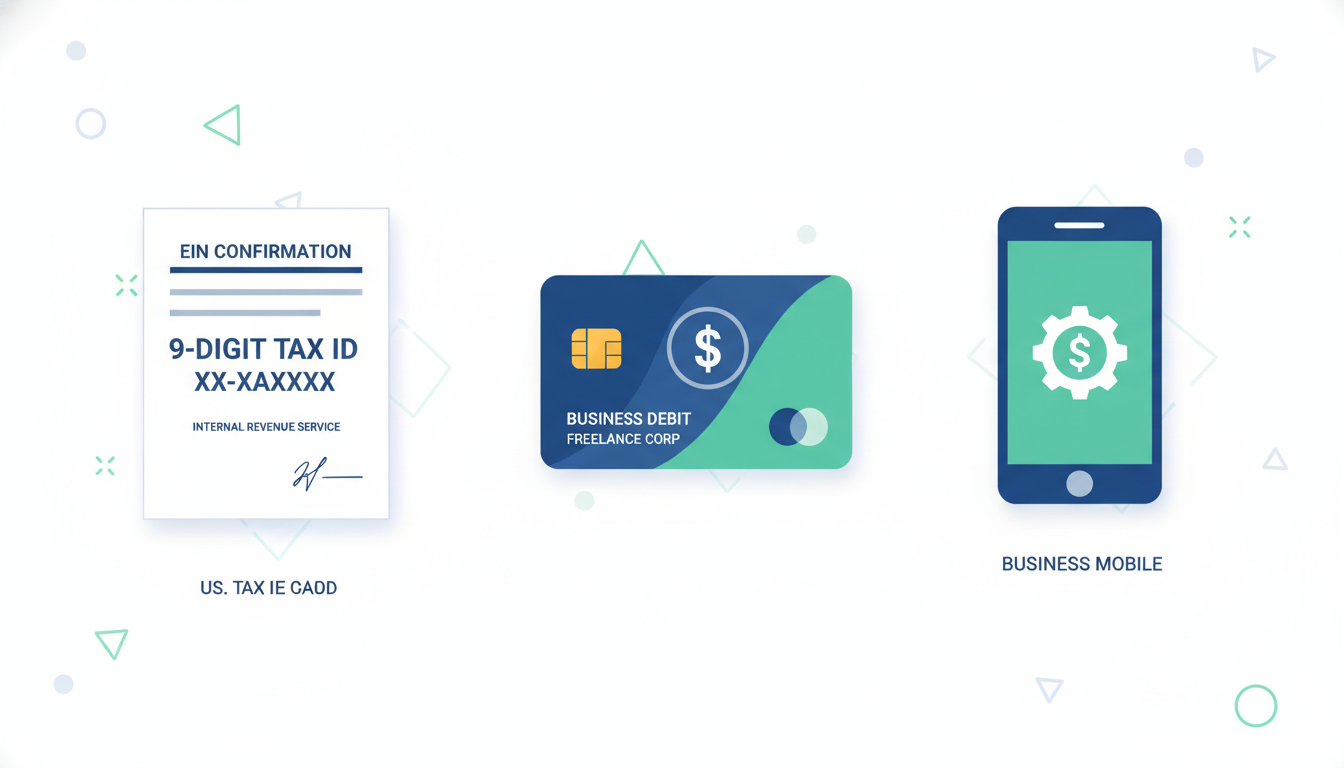
Starting out as a freelancer is exciting—you're finally your own boss. If you're looking for a complete overview of first-time freelancer taxes, we have a dedicated guide for that. But before you send that first invoice or take on your first client, there's some boring but essential paperwork that needs to happen. Skip these steps, and you could face IRS penalties, mix up your personal and business finances, or miss out on legitimate first year freelancer tax deductions.
The good news? All three are free or low-cost to set up, and every dollar you spend on them reduces your taxable income. Let's walk through each one.
Why These Three Matter From Day One
When you're self-employed, the IRS views you as both the employee and the employer. That means you're responsible for keeping accurate records, reporting income correctly, and paying self-employment taxes. Having these three elements in place from the start:
- Protects your personal assets by separating business and personal finances
- Makes tax time dramatically easier with clean records
- Appears professional to clients when you have a business phone number and EIN
- Qualifies you for business tax deductions on Schedule C
Now let's look at each one.
1. EIN: Your Business Identity Number
An EIN for freelancers is a nine-digit tax identification number issued by the IRS. Think of it as your business's Social Security Number. An EIN (Employer Identification Number) is a unique nine-digit number assigned by the IRS to identify your business for tax purposes. If you're wondering how to get an EIN for freelancers, the process is free and takes about 10 minutes online through the IRS website.
Do You Actually Need One?
Yes, if you plan to hire employees (even just yourself counts), operate as a corporation or partnership, or file certain tax forms. According to IRS guidelines, even if not legally required, getting an EIN for freelancers:
- Opens the door to business bank accounts
- Helps separate your personal and business identity
- Is required if you plan to pay yourself a salary later
How to Apply (It's Free)
The fastest way is to apply online through the IRS website. The process takes about 10 minutes, and you'll get your EIN immediately upon completion. No need to pay anyone to do this for you.
Steps:
- Go to the IRS EIN application page
- Select "View Additional Options" and "Apply Online"
- Enter your information (legal name, business structure—likely "Sole Proprietorship" for now, though you may want to read our LLC vs. Sole Proprietorship comparison)
- Get your EIN instantly
Keep a copy of your EIN confirmation letter. You'll need it when opening a business bank account and for your tax filings. For the most current application requirements, check IRS.gov directly.
Tax Deduction
The EIN application itself is free, so there's no cost to deduct. However, if you pay a service to apply on your behalf (which we don't recommend), that fee would qualify as a startup expense on Schedule C, Line 8. These freelance startup expenses tax deduction opportunities include any fees paid for EIN application assistance.
2. Business Bank Account: The Backbone of Freelance Finances
This is arguably the most important step. Mixing personal and business money is the #1 mistake new freelancers make, and it creates a nightmare at tax time.
Why You Need a Separate Account
A business bank account for freelancers is a separate checking account used exclusively for business income and expenses. The IRS requires you to keep business and personal finances separate if you operate as a corporation or partnership. According to IRS Publication 334 (Tax Guide for Small Business), even as a sole proprietor, mixing funds makes it nearly impossible to track deductible expenses. If you're ever audited, commingled accounts raise red flags.
A dedicated business bank account for freelancers also:
- Makes tracking income and expenses automatic
- Simplifies quarterly estimated tax payments
- Projects professionalism when invoicing clients
- Protects your personal assets if you're ever sued
How to Open One
Most major banks and credit unions offer free business checking accounts. You'll need:
- Your EIN (or Social Security Number if sole proprietor with no employees)
- Business formation documents (if incorporated)
- Your driver's license
Business Bank Account Comparison
| Bank/Service | Monthly Fee | Minimum Balance | Best For |
|---|---|---|---|
| Chase Business Complete Banking | $0 | $0 | Traditional bank, large branch network |
| Bank of America Business Advantage | $0 | $0 | Beginners, easy online setup |
| Mercury | $0 | $0 | Digital-first, excellent tools |
| Novo | $0 | $0 | Freelancers, simple interface |
| Local Credit Union | $0-$10 | Varies | Lower fees, personalized service |
Many online banks like Mercury or Novo also offer free business accounts with excellent digital tools.
Tax Deduction
Monthly account fees are tax-deductible as a business expense on Schedule C, Line 17. If you pay for check printing, debit cards, or paper statements, those costs are deductible too. These freelance startup expenses add up—keeping meticulous records means you won't leave money on the table come tax time.
3. Business Phone Line: Professional Communication
Using your personal cell phone number for business might seem fine—until a client texts you at 9 PM on a Saturday about a project deadline. A dedicated business phone line for freelancers keeps boundaries clear and looks professional.
What You Actually Need
You have two main options:
- Second line on your existing phone – Use your carrier's add-a-line feature (typically $10-15/month)
- VoIP service – Services like Google Voice (free), Slack (with workspace), or RingCentral give you a dedicated business number
A business phone line for freelancers is a dedicated phone number used exclusively for business communications, separate from your personal cell phone number.
For most freelancers starting out, Google Voice is the easiest free option—it gives you a separate number that forwards to your phone and includes voicemail transcription.
Business Phone Option Comparison
| Service | Cost | Key Features | Best For |
|---|---|---|---|
| Google Voice | Free | Voicemail transcription, call forwarding, SMS | Budget-conscious freelancers |
| RingCentral | $10-20/mo | Team messaging, video calls, integrations | Growing agencies |
| Slack + Phone Number | $10-15/mo/seat | Integrates with workspace | Already using Slack |
| Carrier Add-a-Line | $10-15/mo | Native calling, no apps needed | Simple needs |
Why This Matters Beyond Convenience
A business phone number serves a practical purpose beyond looking professional:
- Privacy protection – Clients don't need your personal cell number
- Work-life boundaries – Turn off business hours notifications
- Call tracking – If you run ads, you can track which calls convert
- Texting clients – Professional SMS without mixing with friends and family
Tax Deduction
The cost of a business line is fully deductible as a business expense on Schedule C, Line 8. If you use the "percentage of personal phone" method, track your business use carefully. Many freelancers simply deduct 100% if they use a dedicated business line exclusively.
Important Disclaimer
This article provides general information for educational purposes and should not be considered tax advice. Tax regulations are complex and subject to change. The IRS penalty rates mentioned here (failure to file, failure to pay, interest) can vary based on your specific situation and change quarterly. For example, failure-to-file penalties are typically 5% per month up to 25% maximum (15% per month if the failure is deemed fraudulent, up to 75% maximum), while failure-to-pay penalties are typically 0.5% per month up to 25% maximum. Interest rates are set quarterly by the IRS—for the most current rates, check IRS.gov directly.
Always consult with a qualified tax professional or CPA for advice specific to your situation. For the most current penalty rates and tax regulations, visit IRS.gov directly.
Get Ahead of Tax Season
Setting up your EIN for freelancers, business bank account, and business phone line before you start earning isn't just about compliance—it's about building habits that make your entire freelance career smoother.
The time investment is minimal: about 30 minutes total. The tax savings and peace of mind last all year.
At Prefile Check, we help freelancers and 1099 contractors maximize their tax deductions while staying compliant. If you want personalized guidance on which expenses to track and how to organize your freelance finances from day one, we're here to help.
Start your free tax checkup → Our AI analyzes your potential deductions and helps you understand what you can write off before tax season hits.
Related Articles
- First-Time Freelancer Taxes: Your Complete Step-by-Step Guide — Everything new freelancers need to know about taxes
- LLC vs. Sole Proprietorship for Freelancers: A Tax Breakdown — Compare business structures for tax benefits
- Self-Employment Tax Guide for Freelancers — Understand your self-employment tax obligations
- Quarterly Estimated Taxes for Freelancers — Never miss a quarterly payment