Disclaimer: This is not tax advice. Always consult a licensed CPA for your specific tax situation.
Why Freelancers Can't Just Pay Taxes Once a Year
Most new freelancers don't realize this: the U.S. tax system is a pay-as-you-go system.
When you had a W-2 job, your employer handled this for you. Every paycheck, they withheld federal income tax, Social Security, and Medicare. You never had to think about it. The money just disappeared before it hit your bank account.
As a freelancer, nobody withholds anything. Your clients pay you the full amount. That feels great — until April 15th, when the IRS wants their share of the entire year's income all at once.
The IRS doesn't actually want to wait until April. They want their money throughout the year, just like when you had a W-2 employer. The mechanism for this is called quarterly estimated tax payments, and if you skip them, you'll owe penalties on top of your regular tax bill.
Think of it like a gym membership. You can't skip monthly payments all year and then try to settle up in December without a late fee. The IRS works the same way — they expect regular installments.
Who Must Pay Quarterly Estimated Taxes?
If you're earning freelance income, understanding when you need to pay freelancer estimated taxes is crucial. The IRS rule is straightforward. You need to make estimated tax payments if both of these are true:
- You expect to owe $1,000 or more in federal tax for the year (after subtracting withholding and credits)
- You expect your withholding and credits to be less than the smaller of:
- 90% of the tax shown on your current year's return, OR
- 100% of the tax shown on your prior year's return (110% if your AGI was over $150,000)
In plain English: If you're freelancing full-time and earning a decent living, you almost certainly need to pay quarterly. The $1,000 threshold is surprisingly easy to hit. Earning just $7,000 in freelance income typically puts you over that line when you factor in self-employment tax.
Who Might Be Exempt
- Freelancers who also have a W-2 job with enough withholding to cover their freelancer estimated taxes liability
- First-year freelancers who owed $0 in tax last year (the "prior year safe harbor" is $0)
- Anyone whose total tax bill after withholding will be under $1,000
Quarterly Estimated Tax Due Dates for 2026
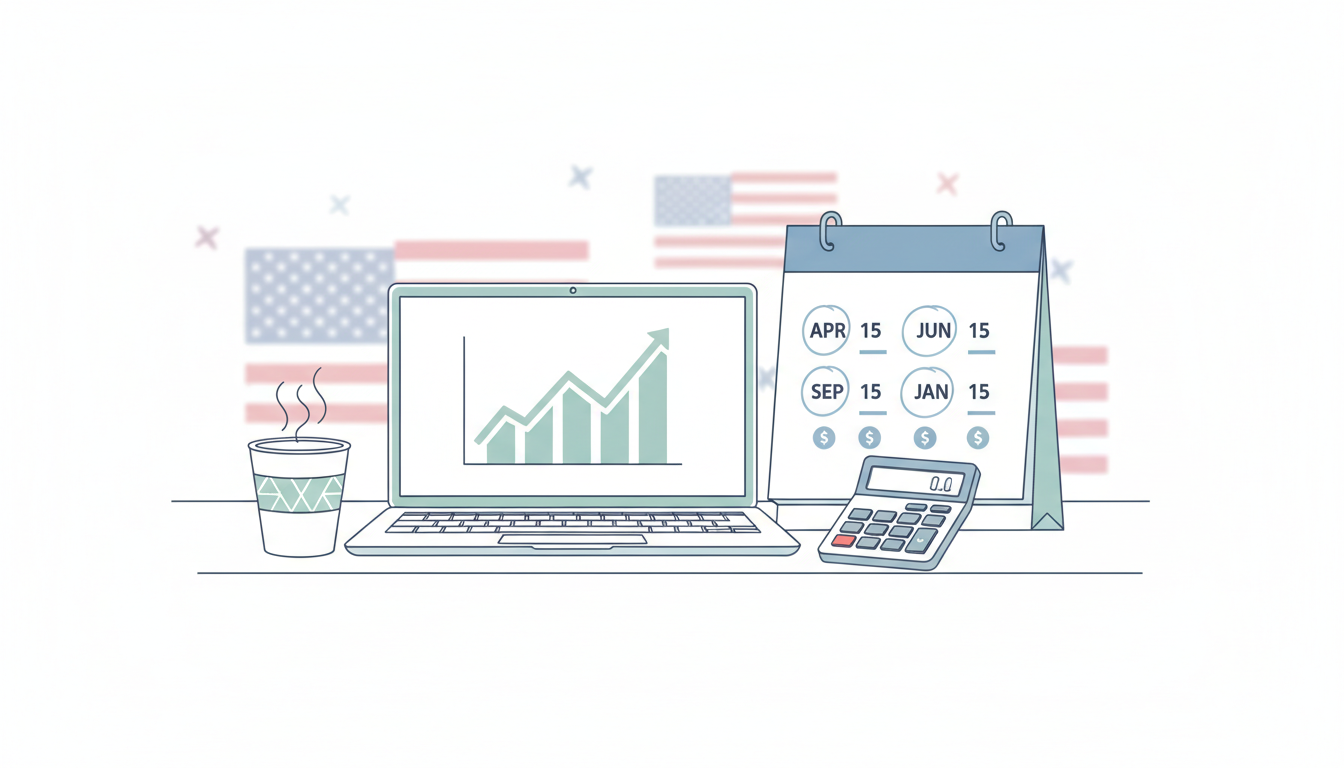
Quarterly estimated taxes aren't due at the end of each calendar quarter. The schedule is slightly irregular, and this trips people up every year:
| Payment Period | Covers Income Earned | Due Date |
|---|---|---|
| Q1 | January 1 – March 31 | April 15 |
| Q2 | April 1 – May 31 | June 15 |
| Q3 | June 1 – August 31 | September 15 |
| Q4 | September 1 – December 31 | January 15 (next year) |
Notice that Q2 only covers two months (April and May), while Q3 covers three months (June through August). This catches many freelancers off guard.
Pro tip: If the due date falls on a weekend or federal holiday, the deadline moves to the next business day. Set calendar reminders at least one week before each due date to give yourself time to calculate and submit.
How to Calculate Quarterly Estimated Taxes: Two Methods
There are two legitimate approaches. Choose the one that matches your situation.
Method 1: Current-Year Estimate (More Accurate)
This method calculates what you'll actually owe based on your current income. It requires more effort but results in more accurate payments.
Step 1: Estimate Your Annual Gross Income
Add up all expected freelance/1099 income for the year. If your income varies month-to-month, use your year-to-date income and extrapolate.
Step 2: Subtract Business Deductions
This is where knowing your deductible expenses matters. Common deductions include:
- Home office expenses
- Software and subscriptions
- Professional development
- Business travel and meals (50%)
- Health insurance premiums
- Equipment and supplies
If you haven't been organizing your expenses into Schedule C categories, now is the time to start. Missing deductions means overestimating your tax and overpaying quarterly.
Step 3: Calculate Self-Employment Tax
Net self-employment income × 92.35% × 15.3% = SE tax
For example, if your net self-employment income is $80,000:
- $80,000 × 0.9235 = $73,880
- $73,880 × 0.153 = $11,303.64 in self-employment tax
You can deduct half of your SE tax from your adjusted gross income.
Step 4: Calculate Income Tax
Apply the 2026 federal tax brackets to your AGI after the standard deduction and the SE tax deduction. Use the IRS Tax Rate Schedule for the current year's brackets.
Step 5: Divide by Four
(Estimated income tax + SE tax – any credits or withholding) ÷ 4 = Quarterly payment
You can pay using IRS Form 1040-ES vouchers or electronically via IRS Direct Pay or EFTPS.
Method 2: Safe Harbor (Simpler)
The safe harbor method is easier: just pay 100% of last year's total tax liability, divided into four equal payments. If your AGI was over $150,000 last year, pay 110% instead.
Why this works: Even if you end up owing more for the current year, the IRS won't charge you an underpayment penalty as long as you met the safe harbor threshold. You'll pay the difference when you file your annual return, but without the penalty.
When to use safe harbor:
- Your income is unpredictable month-to-month
- You're in your first few years of freelancing and income is volatile
- You just want the simplest possible approach
When NOT to use safe harbor:
- Your income dropped significantly from last year (you'll overpay)
- Your income increased dramatically (you might face a large April balance)
The Real Cost of Missing Quarterly Tax Payments
The IRS underpayment penalty is calculated as interest on the amount you should have paid but didn't. The current rate (set quarterly by the IRS) is approximately 7% annually as of 2026.
Let's put that in real numbers:
| Scenario | Annual Tax Owed | Penalty if You Skip All 4 Quarters |
|---|---|---|
| Part-time freelancer | $3,000 | ~$105 |
| Mid-range freelancer | $10,000 | ~$350 |
| Full-time freelancer | $25,000 | ~$875 |
The penalty isn't catastrophic, but it's completely avoidable money that could go toward your business instead.
Important: The penalty is calculated per quarter, not annually. Missing Q1 costs more than missing Q4 because the money is "late" for a longer period. This is why catching up later doesn't fully eliminate the penalty.
A 30-Minute Quarterly System That Works
You don't need an accountant for every quarterly payment. Here's a simple system:
Step 1: Open a Separate Tax Savings Account
Every time you receive client payment, transfer 25-30% to a dedicated savings account. This money is not yours to spend — it belongs to the IRS and your state tax authority.
Think of this account like an escrow account when buying a house. The money is set aside for a specific purpose, and touching it creates problems.
Step 2: Track Your Expenses Monthly
Spend 15 minutes at the end of each month categorizing business expenses. If you have a pile of unorganized receipts and bank statements, tools like Prefile Check can classify them into IRS Schedule C categories automatically. This takes what used to be hours of spreadsheet work and compresses it into minutes.
If you're unsure whether certain expenses qualify as business deductions, check out our guide on gray area tax deductions.
Step 3: Calculate and Pay Each Quarter
One week before each due date:
- Review your income and expenses for the quarter
- Run the calculation (or use your safe harbor number)
- Pay electronically via IRS Direct Pay or EFTPS
- Save the confirmation number
The whole process takes about 30 minutes once you have your expenses organized.
Common Quarterly Tax Mistakes to Avoid
Mistake 1: Forgetting State Estimated Taxes
Federal quarterly taxes get all the attention, but most states with income tax also require quarterly estimated payments. The due dates usually mirror the federal schedule, but some states differ. Check your state's department of revenue website.
Mistake 2: Not Adjusting Mid-Year
If you land a huge client in Q3 and your income jumps significantly, your Q1/Q2 payments based on last year's safe harbor might not be enough to avoid a penalty on the increased income. Consider using the annualized income installment method (IRS Form 2210, Schedule AI) to adjust.
Mistake 3: Confusing Gross Revenue with Net Income
Your quarterly estimated tax is based on net self-employment income (revenue minus business expenses), not gross revenue. If you gross $100,000 but have $30,000 in legitimate business deductions, your SE tax is calculated on $70,000, not $100,000.
This is exactly why organizing your expenses properly isn't just a tax season activity — it directly affects how much you pay each quarter.
Mistake 4: Paying the Wrong Amount After a Bad Year
If you had a great year last year but this year is slow, the safe harbor method will have you overpaying. Switch to the current-year estimate method and base payments on what you're actually earning now.
Mistake 5: Missing the January 15 Deadline
Q4 estimated taxes are due January 15 of the following year, not December 31. Many freelancers forget this payment because it comes during the holiday season. There's an exception: if you file your tax return and pay all remaining tax by January 31, you can skip the Q4 estimated payment.
What To Do If You're Behind on Quarterly Payments
If you've missed one or more quarterly payments, here's what to do:
- Pay what you owe now. The penalty accrues daily, so paying late is still better than paying later.
- Don't skip future payments. Catching up on Q1 doesn't exempt you from Q2.
- Consider the annualized method. If your income was genuinely low in earlier quarters and spiked later, Form 2210 Schedule AI can reduce or eliminate your penalty.
- File on time. Late filing penalties (5% per month) are much worse than underpayment penalties (~7% annually). Always file on time, even if you can't pay in full.
If this is your first year dealing with freelance taxes, don't panic. Get organized now and set up the quarterly system going forward.
2026 Estimated Tax Key Numbers
Here are the key numbers for 2026:
- SE tax rate: 15.3% (12.4% Social Security + 2.9% Medicare)
- Social Security wage base: $184,500 (2026)
- Standard deduction (single): $16,100 (2026)
- Underpayment penalty rate: 7% (Q1 2026), 6% (Q2 2026) — set quarterly by IRS
- Safe harbor threshold: 100% of prior year tax (110% if AGI > $150,000)
- Minimum to trigger estimated tax requirement: $1,000 expected tax owed
The bottom line: Freelancer estimated taxes aren't optional for most self-employed workers, and missing quarterly payments costs real money in penalties. But the system isn't complicated once you set it up. Dedicate 30 minutes per quarter, keep your expenses organized, and you'll never face an underpayment surprise again.