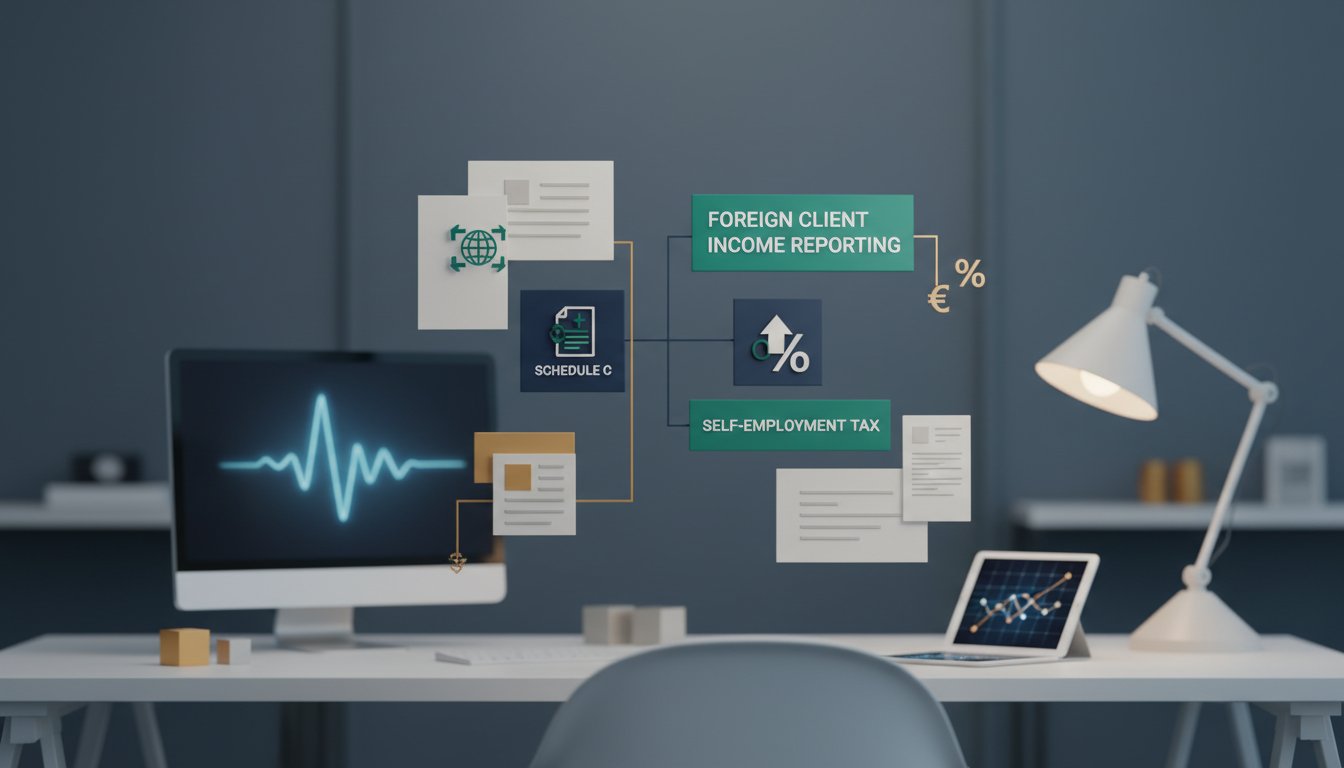
Foreign client income on Schedule C is income earned by US freelancers from clients located outside the United States, received in foreign currencies and converted to US dollars for reporting on the tax return. Unlike domestic self-employment earnings, foreign client income may trigger tax obligations in the client's country in addition to US taxes, creating a dual-compliance requirement. Foreign client income schedule c is taxed the same as domestic self-employment income for US tax purposes — all worldwide earnings must be reported in US dollars regardless of where the client is located.1 The primary distinction lies in how the income is characterized: a US freelancer receiving payment from a foreign client reports that foreign client income schedule c the same way as any other self-employment earnings, with the additional consideration of potential foreign taxation and currency conversion requirements.
How Foreign Client Income Is Taxed on Schedule C
Foreign client income schedule c is taxed the same as domestic self-employment income for US tax purposes — all worldwide earnings must be reported in US dollars regardless of where the client is located.1
The IRS treats foreign client income identically to domestic income for self-employment tax purposes. Net earnings from foreign clients flow through Schedule C to Schedule SE, where the 15.3% self-employment tax rate applies — 12.4% for Social Security and 2.9% for Medicare.2 This means a freelancer earning $60,000 from international clients pays the same $8,477 in self-employment tax (after the 92.35% adjustment on Schedule SE) as one earning the same amount from US clients.
The key distinction is that foreign client income may also be subject to income tax in the client's country. Without proper planning, a freelancer could owe tax to both the US and a foreign government on the same earnings. The US provides relief through the foreign tax credit on Form 1116, but this credit offsets income tax only — not self-employment tax.3
A freelance developer earning $80,000 from a UK-based client faces potential UK income tax withholding at source of roughly 20% — $16,000 on this income. The freelancer reports the full $80,000 on Schedule C, pays self-employment tax on the net earnings, and claims a foreign tax credit for the UK income tax paid. The self-employment tax portion remains due to the IRS regardless.
Reporting Foreign Client Income on Schedule C Line 1
Line 1 of Schedule C asks for gross receipts or sales. Foreign client income goes here, converted to US dollars using the exchange rate on the date you received payment.4 The IRS does not allow you to use the average annual exchange rate for Schedule C reporting — each payment must be converted individually.
For a freelancer receiving monthly payments of €5,000 from a German client, each payment converts at the spot rate on the day it hits the bank account. If the rate was 1.08 on January 15 and 1.12 on February 15, the January payment reports as $5,400 and February as $5,600.5 The total for the year is the sum of each individually converted payment.
The IRS provides no simplified method for currency conversion on Schedule C. Freelancers must maintain a log of payment dates, original currency amounts, exchange rates used, and resulting US dollar figures. The IRS may request this documentation during an audit, and without it, the agency can reconstruct income using unfavorable rates.
How to Handle 1099-NEC vs No Form for Foreign Clients
Foreign clients are not required to issue Form 1099-NEC to US freelancers — the IRS reporting requirement applies only to US payers.5 A freelancer who receives no 1099-NEC from a foreign client still must report the full amount on Schedule C.
Foreign client income schedule c reporting is required regardless of whether the client provides a 1099-NEC form. This creates a common error pattern where freelancers assume the foreign income is not reportable simply because no form arrived. The IRS cross-checks bank deposits against reported income, and unreported foreign payments appear as unexplained deposits.
A freelance writer earning $40,000 from US clients (reported on 1099-NEC forms) and $25,000 from a Canadian publisher (no form) faces a discrepancy the IRS will notice. The agency sees $65,000 in bank deposits but only $40,000 on Schedule C. The freelancer must then prove the $25,000 was foreign client income and file an amended return.
Currency Conversion Rules for Schedule C Income Reporting
The IRS requires freelancers to convert foreign currency to US dollars using the exchange rate prevailing on the date of receipt.4 This is the spot rate — the rate at which the foreign currency could be exchanged for US dollars on that specific day.
Freelancers have two acceptable sources for exchange rates. The IRS publishes monthly average rates that can be used for recurring payments of the same amount. For variable payments, the Federal Reserve's daily rate or a commercial rate from a bank or financial platform is acceptable. The key requirement is consistency — once a freelancer chooses a rate source, they should use it for the entire tax year.
A freelancer receiving irregular payments from clients in Japan, Australia, and the EU must track three separate currencies. Each payment converts at its own date-specific rate. The total Schedule C income is the sum of all converted amounts, not a single conversion of the aggregate foreign currency total.
Tax Treaty Benefits That Affect Your Schedule C Income
The US has income tax treaties with over 60 countries that can reduce or eliminate double taxation on foreign client income.6 These treaties typically determine which country has primary taxing rights over specific types of income.
For freelancers, the relevant treaty provision is usually the "business profits" article. Most treaties allow the client's country to tax the income only if the freelancer has a permanent establishment — a fixed place of business — in that country. A freelancer working from a home office in the US generally does not have a permanent establishment abroad, meaning the foreign country should not tax the income.
In practice, foreign clients may still withhold tax at source regardless of treaty provisions. The freelancer must then claim a refund from the foreign tax authority or use the foreign tax credit on Form 1116. Treaty benefits do not reduce self-employment tax — they affect only income tax.
Deducting Foreign Business Expenses on Schedule C
Foreign business expenses are deductible on Schedule C under the same rules as domestic expenses. The expense must be ordinary and necessary for the trade or business.7 Currency conversion costs, international wire transfer fees, and foreign bank account charges are all deductible.
Travel expenses for meeting foreign clients follow the same substantiation rules as domestic travel. A freelancer traveling to London for a client meeting can deduct airfare, lodging, and 50% of meals.8 The key difference is that foreign travel may be subject to limits on luxury water transportation and the requirement to allocate travel days if the trip combines business and personal purposes.
A freelancer attending a conference in Tokyo pays $2,000 for airfare, $1,500 for lodging, and $800 for meals. The airfare and lodging are fully deductible. The meals are 50% deductible, for example at $400. If the freelancer stays an extra week for vacation, the airfare must be allocated between business and personal days.
Foreign Tax Credit vs Schedule C Deduction Strategy
The foreign tax credit on Form 1116 is the primary mechanism for avoiding double taxation on foreign client income.3 It allows a dollar-for-dollar credit against US income tax for income taxes paid to a foreign country. The credit cannot exceed the US tax liability attributable to the foreign income.
A freelancer paying $3,000 in foreign income tax on $30,000 of foreign client income can claim a credit of up to $3,000 against US income tax. If the US tax on that income is only $2,500, the credit is limited to $2,500, and the remaining $500 carries forward to future years.4
The alternative is deducting foreign taxes as an itemized deduction on Schedule A. This is almost always less beneficial than the credit because a deduction reduces taxable income rather than directly offsetting tax. The foreign tax credit is generally the better choice for freelancers with foreign client income.
| Strategy | Benefit | Limitation |
|---|---|---|
| Foreign Tax Credit (Form 1116) | Dollar-for-dollar reduction of US income tax | Does not offset self-employment tax; limited to US tax on foreign income |
| Foreign Tax Deduction (Schedule A) | Reduces taxable income | Less valuable than credit; requires itemizing |
| Treaty-Based Position | Eliminates foreign tax entirely | Requires no permanent establishment; foreign client may still withhold |
Quarterly Estimated Tax Payments With Foreign Client Income
Freelancers with foreign client income must make quarterly estimated tax payments using Form 1040-ES, just as they would with domestic income.8 The estimated tax calculation must include both income tax and self-employment tax on the foreign earnings.
The complication arises when foreign clients withhold tax at source. Suppose a freelancer expects $50,000 in foreign client income with 15% foreign withholding — they must account for the withholding when calculating estimated payments. The foreign tax credit will offset the US income tax, but the self-employment tax remains due quarterly.
If the first foreign payment arrives in March rather than January, the estimated payment due April 15 must include self-employment tax on that payment. If the freelancer waits until the June payment to start estimating, they may owe a penalty for underpayment of estimated tax.
Your Next Step
Open your bank statements for the past tax year and identify every deposit from a foreign client. Create a spreadsheet with columns for payment date, original currency, amount, exchange rate used, and US dollar equivalent. If you have not been tracking exchange rates at the time of receipt, use the Federal Reserve's historical rate database to reconstruct the conversions. Then compare your total foreign client income against what you reported on Schedule C. If the numbers do not match, file Form 1040-X to amend your return before the IRS sends a notice.
Footnotes
-
https://ttlc.intuit.com/community/taxes/discussion/how-to-report-freelance-income-obtained-from-company-outside-of-the-us/00/969084 ↩ ↩2
-
https://www.irs.gov/businesses/small-businesses-self-employed/self-employment-tax ↩
-
https://brighttax.com/blog/schedule-c-a-guide-for-expat-freelancers-small-business-owners/ ↩ ↩2
-
https://www.greenbacktaxservices.com/knowledge-center/foreign-self-employment-taxes/ ↩ ↩2 ↩3
-
https://www.irs.gov/businesses/international-businesses/united-states-income-tax-treaties-a-to-z ↩