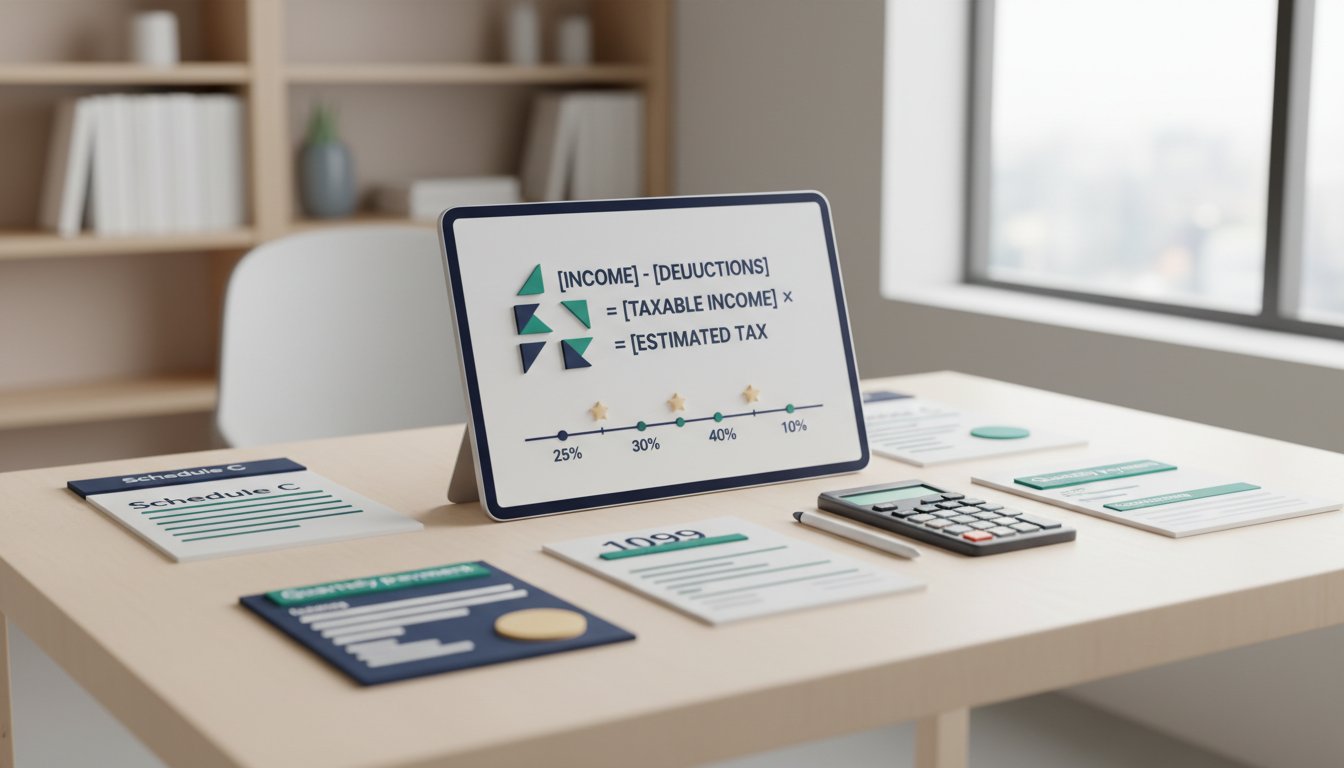
The Self-Employment Tax Foundation (15.3% Explained)
Freelance income tax percentage set aside is the specific portion of each payment a freelancer should transfer to a separate savings account to cover their future self-employment and income tax liabilities. Getting this percentage right prevents a large, unexpected tax bill and avoids IRS underpayment penalties.
The core tax obligation for freelancers is the self-employment tax, a flat 15.3% rate applied to net earnings1. This tax funds Social Security (12.4%) and Medicare (2.9%). Unlike a W-2 employee, a freelancer pays both the employer and employee portions of these contributions. This tax is due whenever net earnings from self-employment exceed $400 for the year, which triggers the requirement to file a Schedule C with your tax return2.
The calculation applies to 92.35% of your net profit, a statutory adjustment that approximates the employer-half of these taxes being deductible. For a hypothetical freelancer with a net profit of $70,000, the self-employment tax calculation would be: ($70,000 * 0.9235) * 0.153 = $9,889. This is a baseline cost of doing business, owed before any federal or state income tax is calculated.
| Tax Component | Rate | Applies To | Notes |
|---|---|---|---|
| Social Security | 12.4% | Net earnings up to the annual limit3 | The wage base limit changes yearly. |
| Medicare | 2.9% | All net earnings | No income cap. |
| Additional Medicare Tax | 0.9% | Net earnings above a threshold4 | Applies at $200,000 for single filers. |
| Total SE Tax | 15.3% | Net earnings (via 92.35% adjustment) | The foundational freelancer tax. |
Why the 30% Rule Is Wrong for Most Freelancers
A common blanket recommendation is to set aside 25-30% of every freelance payment for taxes. While simple, this rule is often inaccurate and can significantly harm a freelancer's cash flow. The "right" percentage is not a universal constant; it is a variable output of your specific income, deductions, filing status, and state of residence.
Consider a hypothetical freelance graphic designer, Michael, who earns $85,000 in gross income. After claiming $15,000 in legitimate business deductions for software, a home office, and marketing, his net profit is $70,000. His total federal tax liability, after calculating self-employment tax and income tax, might be approximately $15,000. This results in an effective tax rate of about 17.7% of his gross income. A rigid 30% set-aside would cause him to over-withhold $10,500 for the year—money that could have been used for business investment or savings.
Conversely, a freelance consultant in a high-tax state with fewer deductions might have an effective rate pushing 35%. Using a 30% rule would lead to under-withholding and a penalty. The error of the one-size-fits-all percentage is clear: it ignores the individual levers that determine tax liability.
How to Calculate Your True Effective Tax Rate
To move beyond guesswork, freelancers need to calculate their personalized effective tax rate. This requires projecting your annual numbers and running a simplified tax calculation. Here is a step-by-step method using a hypothetical scenario for a single filer.
Step-by-Step Calculation for a Single Filer:
- 1. Estimate Gross Freelance Income: Project your total annual income from 1099 work. For example, say a freelancer expects $85,000.
- 2. Estimate Business Deductions: Total your anticipated deductible business expenses. A typical freelancer might have $15,000 for items like home office, internet, supplies, and mileage.
- 3. Calculate Net Profit (Schedule C Line 31): Subtract deductions from gross income. $85,000 - $15,000 = $70,000 net profit.
- 4. Calculate Self-Employment Tax: ($70,000 * 0.9235) * 0.153 = $9,889.
- 5. Calculate Federal Income Tax: Determine taxable income after the standard deduction and the deductible portion of SE tax, then apply the current tax brackets. On the remaining taxable income, the federal income tax might be approximately $5,150.
- 6. Calculate Total Tax Liability: $9,889 (SE Tax) + $5,150 (Income Tax) = $15,039.
- 7. Calculate Effective Tax Rate: Divide total tax liability by gross income. $15,039 / $85,000 = 17.7%.
This 17.7% is your target set-aside rate on gross payments. You must also add your state income tax rate, if applicable. For instance, a 5% state tax rate would bring the total set-aside to 22.7%.
The Self-Employment Tax: Your 15.3% Baseline
Understanding the mechanics of the self-employment tax is crucial because it forms the non-negotiable floor of your tax obligation. As established, this 15.3% tax applies to your net profit1. However, two critical modifiers affect the final amount.
The first modifier is the Social Security wage base. The Social Security portion (12.4%) only applies to net earnings up to an annual limit, which is adjusted for inflation3. Earnings above this cap are not subject to the Social Security tax, though the 2.9% Medicare portion still applies.
The second modifier is the Additional Medicare Tax. High-earning freelancers are subject to an Additional Medicare Tax of 0.9% on net earnings exceeding $200,000 for single filers4. This can raise the effective self-employment tax rate above the baseline 15.3% for a portion of income.
| Income Scenario | Social Security Tax Applies | Medicare Tax Applies | Additional Medicare Tax | Effective SE Tax Rate |
|---|---|---|---|---|
| Net earnings below the wage base | Yes (12.4%) | Yes (2.9%) | No | 15.3% |
| Net earnings above wage base but below $200k | No | Yes (2.9%) | No | 2.9% |
| Net earnings above $200k | No | Yes (2.9%) | Yes (0.9%) | 3.8% |
Quarterly Estimated Tax Payments and the Safe Harbor Rule
The IRS requires taxes to be paid as income is earned, not in one lump sum every April. For freelancers without withholding, this is done through quarterly estimated tax payments. The deadlines are April 15, June 15, September 15, and January 15 of the following year.
To avoid underpayment penalties, you must meet one of two safe harbor requirements5. The first option is paying at least 90% of your current year's total tax liability through timely estimated payments. The second option is paying 100% of your prior year's total tax liability (110% if your prior year Adjusted Gross Income exceeded $150,000).
The second safe harbor is the most powerful tool for freelancers with variable income. If your income spikes unexpectedly, you are protected from penalties as long as you pay 100% of last year's tax bill in equal quarterly installments. Any remaining balance for the current year is due by the April filing deadline. This rule provides a predictable payment target amidst income fluctuation.
Deductions That Lower Your Taxable Income
Deductions directly reduce your net profit on Schedule C, which in turn lowers both your self-employment tax and your income tax. Common and often overlooked deductions include the Home Office Deduction. Using the simplified method, you can deduct $5 per square foot of your home used exclusively for business, up to 300 square feet.
Another major deduction is the Business Use of Vehicle. Track mileage for client meetings, supply runs, and other business travel. The standard mileage rate is set annually by the IRS.
Software and subscriptions also qualify. Costs for project management tools, design software, cloud storage, and industry publications are deductible.
Education and professional development matters too. Courses, conferences, and books that maintain or improve skills needed for your current freelance work qualify as deductions.
Finally, health insurance premiums may be deductible. If you are not eligible for a plan through a spouse or employer, premiums for medical, dental, and qualifying long-term care insurance for yourself and your dependents may be deductible.
Maximizing legitimate deductions is the most effective way to lower your effective tax rate and the corresponding percentage you need to set aside.
Setting Up a Separate Tax Savings Account
The single most effective behavioral system for tax compliance is a dedicated, separate savings account. The moment a client payment hits your primary business checking account, immediately transfer your calculated tax percentage to this "Tax Trust" account. This action physically separates the IRS's share from your operating capital, eliminating the temptation to spend it.
Treat this account as untouchable for any purpose other than making quarterly estimated tax payments. Use a high-yield savings account to earn a modest return on these funds throughout the year. Automating the transfer removes the mental burden and ensures consistency. Either use your bank's recurring transfer feature or set up a rule within your accounting software.
Adjusting Your Set-Aside Rate Throughout the Year
Your effective tax rate is not set in January and forgotten. You should recalibrate your set-aside percentage at least quarterly, coinciding with estimated tax deadlines. A mid-year review is essential if you land a large new contract or experience a significant drop in expected income.
The process for a mid-year adjustment involves four steps. First, update your projections by totaling year-to-date gross income and deductions. Second, re-forecast the remainder of the year by estimating income and expenses for the rest of the year based on your pipeline. Third, re-run your effective rate calculation using the new full-year projections to calculate a revised tax liability and effective rate. Fourth, adjust your transfer percentage by increasing or decreasing the percentage you move to your tax savings account from each new payment accordingly.
This proactive adjustment prevents a large deficit or an excessive surplus in your tax fund by year-end.
Your Next Step
Stop guessing. Take 30 minutes this week to project your annual freelance income and list your expected business deductions. Use the step-by-step calculation method outlined above to determine your personalized effective tax rate. Once you have that percentage, immediately open a separate high-yield savings account and label it "Tax Trust." Set up an automatic transfer rule to move that percentage from every incoming client payment into this account. This single action transforms tax planning from a source of anxiety into a manageable, systematic process.
Footnotes
-
Internal Revenue Service. "Self-Employment Tax." IRS.gov. https://www.irs.gov/businesses/small-business-self-employed/self-employment-tax ↩ ↩2
-
Internal Revenue Service. "Schedule C (Form 1040), Profit or Loss from Business." Instructions state filing is required if net earnings from self-employment are $400 or more. https://www.irs.gov/forms-pubs/about-schedule-c-form-1040 ↩
-
Social Security Administration. "Contribution and Benefit Base." The wage base limit is adjusted annually. https://www.ssa.gov/oact/cola/cola.html ↩ ↩2
-
Internal Revenue Service. "Questions and Answers for the Additional Medicare Tax." IRS.gov, threshold for single filers. https://www.irs.gov/forms-pubs/questions-and-answers-on-the-additional-medicare-tax ↩ ↩2
-
Internal Revenue Service. "Estimated Taxes." IRS.gov, outlines the 90% current year and 100%/110% prior year safe harbor rules. https://www.irs.gov/businesses/small-business-self-employed/estimated-taxes ↩