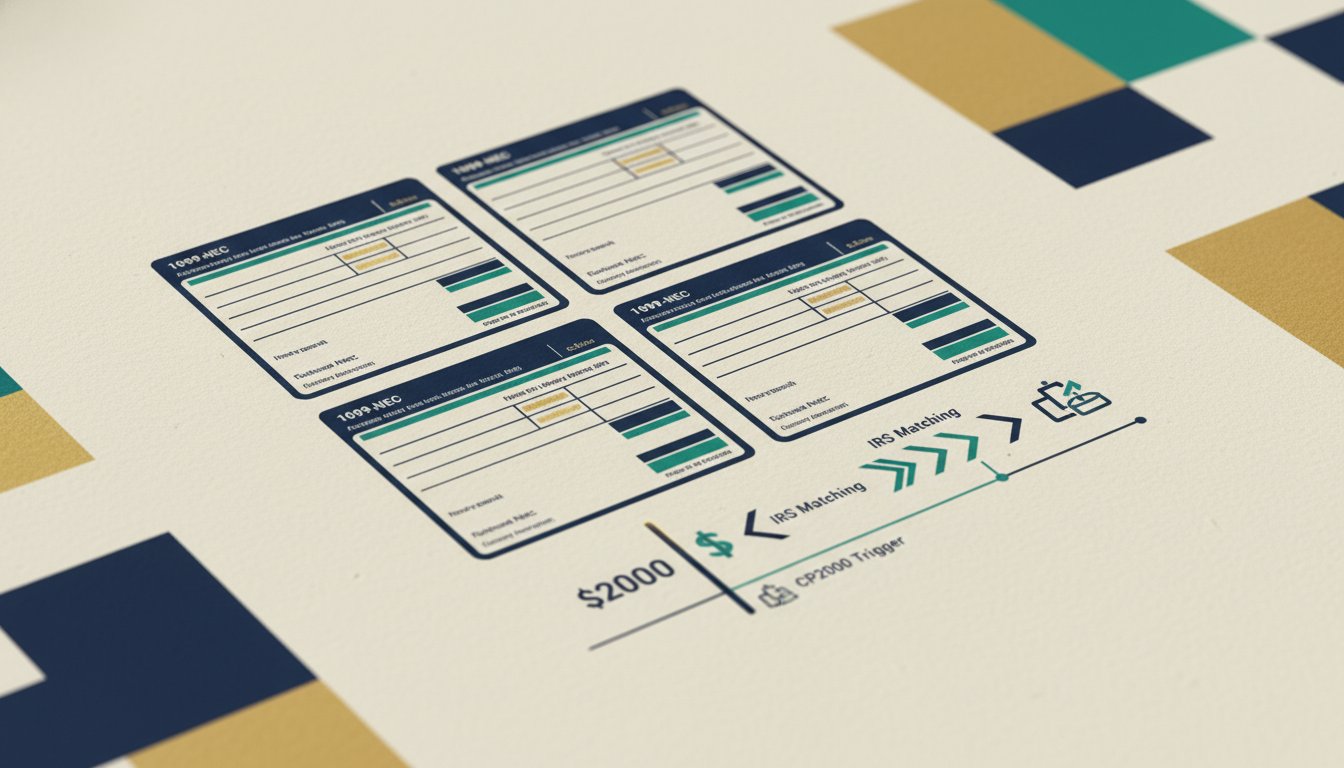
What the $2,000 Threshold Actually Means for Freelancers
However, the $2,000 threshold applies per payer per year, not per freelancer.1
A "multiple 1099 nec under 2000" situation occurs when a freelancer receives several 1099-NEC forms, each from a different client paying less than $2,000, and must correctly report the aggregate total to avoid an IRS mismatch notice. The key distinction: this threshold is a reporting requirement for payers, not a tax exemption for recipients.
Consider a hypothetical freelance graphic designer earning $80,000 annually from ten clients. If each client pays between $1,200 and $1,900 — for example, a typical retainer arrangement — none of those clients must issue a 1099-NEC. The freelancer still owes tax on the full $80,000 and must report it on Schedule C.2 The absence of 1099-NEC forms does not mean the income is untaxed.
Freelancers who assume "no 1099 means no tax" are the ones most likely to receive a CP2000 notice later. When multiple small clients fall below the threshold, the IRS database may show zero reported income for that SSN, even though the freelancer correctly reported thousands in Schedule C income.
Why Multiple 1099-NECs Still Need Aggregate Reporting
Even when each 1099-NEC falls below $2,000, the IRS expects freelancers to aggregate all 1099-NEC amounts when reporting on Schedule C.2 The IRS Automated Underreporter (AUR) program compares the total income reported on your tax return against the sum of all information returns (1099-NEC, 1099-K, W-2) filed under your Social Security Number.
| Scenario | Number of Clients | Each Payment | 1099-NEC Issued? | Total Reported to IRS | Freelancer Must Report |
|---|---|---|---|---|---|
| A | 3 | $1,500 | No (under $2,000) | $0 | $4,500 |
| B | 5 | $1,800 | No (under $2,000) | $0 | $9,000 |
| C | 2 | $2,500 | Yes | $5,000 | $5,000 |
Scenario A and B are where CP2000 risk is highest. The IRS database shows zero 1099-NEC income for that SSN, but the freelancer reports, for example, $4,500 or $9,000. The system flags this as a potential understatement of income, not overstatement.
The solution: maintain client contracts, invoices, and payment records that prove the income is real and was properly reported. When a freelancer with multiple 1099-NEC forms under $2,000 receives a mismatch notice, the documentation system built throughout the year becomes the response package.
How IRS CP2000 Matching Works with Multiple Forms
The IRS Automated Underreporter (AUR) program runs a computer match between income reported on your tax return and income reported on information returns like 1099-NEC, 1099-K, and W-2 forms.3 When the total on your return exceeds the total in the IRS database by more than a tolerance threshold, the system generates a CP2000 notice.
For freelancers with multiple 1099-NEC forms under $2,000, the mismatch works in reverse. The IRS database may show no 1099-NEC income because no payer filed a form. Your return shows, for example, $12,000 in Schedule C income. The system flags a $12,000 discrepancy and proposes additional tax, penalties, and interest.
The IRS does not know whether the income came from one client or twenty. It only sees the gap between what was reported to it via information returns and what you reported on your tax return. This is why freelancers who meticulously track all income from all sources are still at risk if their clients fall below the filing threshold.
Common CP2000 Triggers for Freelancers with Multiple 1099s
The most common CP2000 trigger for freelancers with multiple small 1099s is a mismatch between Schedule C gross receipts and the total of all 1099-NEC forms filed under their SSN. Three specific scenarios generate the most notices when a freelancer has multiple 1099-NEC forms under $2,000:
Missing income from non-filing payers. Suppose a freelancer reports $25,000 in Schedule C income, but only $8,000 appears on 1099-NEC forms in the IRS database. The remaining income came from clients who paid under $2,000 and did not file — a common gap for freelancers with many small clients. The IRS assumes the unreported portion is overstated and issues a CP2000.
Incorrect business expense netting. Some freelancers report net income instead of gross receipts on Schedule C line 1. If the IRS database shows $15,000 in 1099-NEC income and the return shows $10,000 in gross receipts, the system flags a $5,000 underreporting.
Misclassified income. A freelancer receives a 1099-NEC for, say, $1,500 but reports it as hobby income or "other income" on Schedule 1 instead of Schedule C. The IRS matching system may not connect the two entries, generating a CP2000 for the unreported amount.
Step-by-Step: Responding to a CP2000 Notice
A CP2000 notice is a proposal, not a final bill. Freelancers have the right to respond before any adjustment is made to their account.
Step 1: Verify the notice details. Confirm the tax year, the amount of proposed additional tax, and the specific income items the IRS claims were underreported. The notice will list each 1099-NEC form the IRS has on file and the amount reported on your return.
Step 2: Gather your records. Collect all 1099-NEC forms you received, client contracts, invoices, bank statements, and payment processor records (PayPal, Stripe, Venmo business accounts). Organize them by client and payment date.
Step 3: Compare IRS data to your records. Create a simple spreadsheet listing each client, the amount they paid, whether they issued a 1099-NEC, and the amount you reported on Schedule C. Identify any discrepancies.
Step 4: Respond in writing. The CP2000 notice includes a response form and a deadline (typically 30 days). Write a clear explanation of each discrepancy. For example, if the IRS database shows $0 but you reported $12,000, explain that your clients paid under $2,000 each and attach invoices and bank statements as proof.
Step 5: Send via certified mail. Use the address provided in the notice. Keep copies of everything. The IRS typically processes responses within 60 to 120 days.
Proactive Documentation to Prevent CP2000
The best CP2000 response is the one you never have to write. Freelancers with multiple small 1099s should maintain a documentation system that proves income before the IRS asks.
| Document Type | What It Proves | Retention Period |
|---|---|---|
| Client contracts | Scope of work and payment terms | 7 years after project completion |
| Invoices | Amount billed and date | 7 years |
| Bank deposit records | Payment received | 7 years |
| Payment processor statements | Transaction history | 7 years |
| Email payment confirmations | Client-payer relationship | 7 years |
A freelancer who receives income from multiple clients — for example, $1,500 from five clients — should keep a master income log with client name, payment date, invoice number, and payment method. When tax season arrives, this log becomes the source document for Schedule C reporting. If a CP2000 arrives two years later, the log plus supporting invoices and bank records provide the evidence needed to close the case.
Your Next Step
Request your IRS wage and income transcript for the most recent tax year using Form 4506-T. Compare the total 1099-NEC income listed on the transcript against your Schedule C gross receipts. If you find a gap, create a supporting schedule listing each client, payment amount, and the reason no 1099-NEC was issued. File this schedule with your next return. For freelancers who want automated transcript comparison and CP2000 risk scoring, PreFileCheck offers a tool that matches your income records against IRS data before you file.