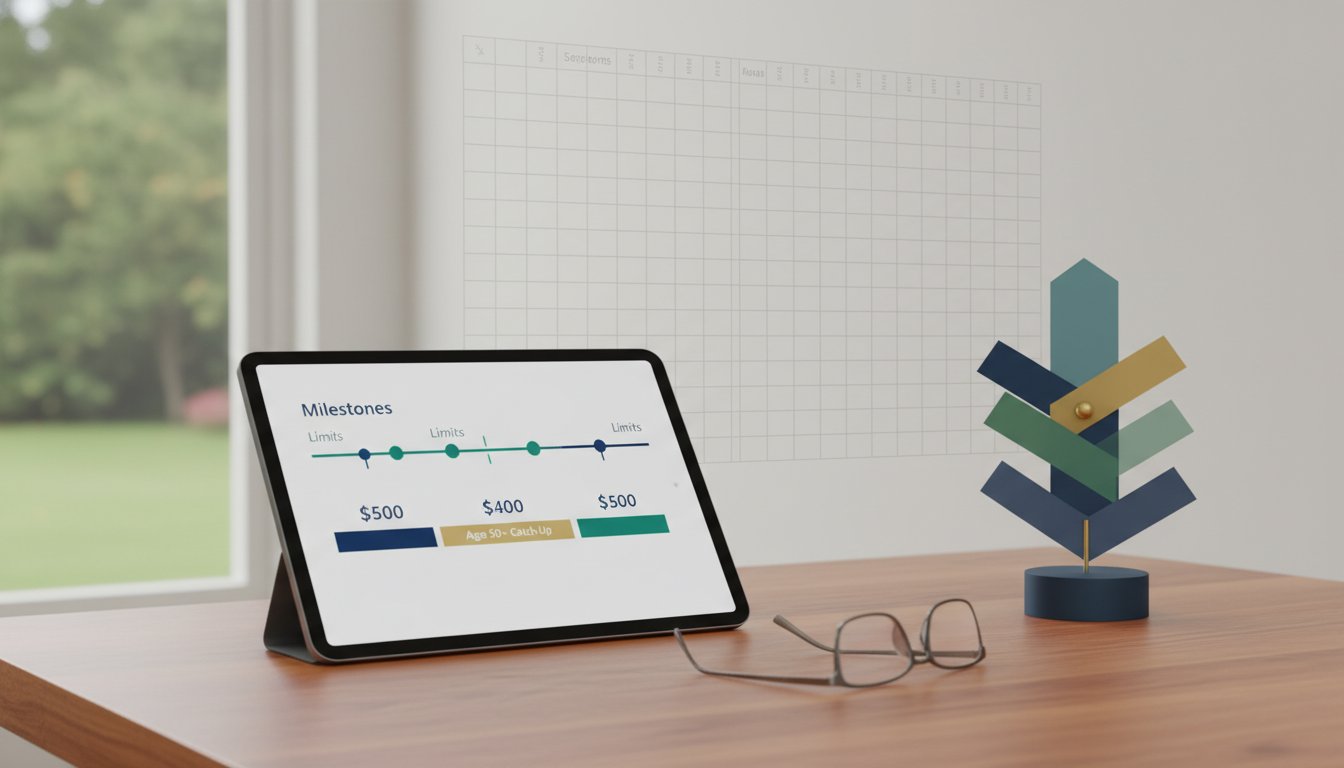
A solo 401k catch-up contribution for self-employed freelancers age 50+ is an extra pre-tax contribution that sits on top of the standard $23,000 employee deferral limit. For freelancers asking how the solo 401k catch-up contribution freelancers can use works, the answer is straightforward: once you turn 50, the IRS allows an additional $7,500 contribution on top of the standard limit. Unlike W-2 employees who are capped at standard 401k limits, self-employed workers can contribute in two roles — as employee and employer — and add this extra catch-up amount to accelerate retirement savings while reducing their current tax bill.
How Solo 401k Catch-Up Contributions Work for Freelancers 50+
A solo 401k catch-up contribution for self-employed freelancers age 50+ is an extra pre-tax contribution that sits on top of the standard $23,000 employee deferral limit. If you are a self-employed freelancer over 50, a solo 401k catch-up contribution freelancers can use is one of the most powerful tools available to accelerate retirement savings while reducing your current tax bill. Unlike employees who are capped at standard 401k limits, freelancers can contribute in two roles — as employee and employer — and add an extra catch-up amount once they turn 50.
A solo 401k (also called an individual 401k) is a retirement plan designed for self-employed individuals with no full-time employees other than a spouse. It allows you to make contributions in two capacities: as an employee making elective deferrals, and as an employer making profit-sharing contributions.
Once you turn 50, the IRS allows an additional catch-up contribution on top of the standard employee deferral limit. For 2025, that catch-up amount is $7,5001. This means a freelancer age 50 or older can defer up to $30,500 as an employee (the standard limit plus the catch-up), plus up to roughly 20% of net self-employment income as an employer profit-sharing contribution, subject to the overall cap.
The catch-up contribution is entirely optional — you do not have to max out the standard deferral to use it. If you contribute $15,000 as an employee deferral, you can still add the full $7,500 catch-up, bringing your employee-side total to $22,500.
Why Freelancers Over 50 Need a Solo 401k Catch-Up Strategy
Freelancers face a retirement savings gap compared to W-2 employees. Without an employer match, the entire burden falls on the individual. The catch-up provision is designed specifically to address this shortfall for older workers who started saving later or experienced income volatility.
Consider a hypothetical freelance consultant earning $120,000 in net self-employment income. This consultant can contribute $23,000 as an employee deferral, plus the $7,500 catch-up for ages 50 and older. They can also add employer profit-sharing of approximately $22,500 (roughly 20% of net earnings after the SE tax adjustment). Without a catch-up strategy, their maximum employer profit-sharing alone would be around $22,500, totaling $45,500 combined with the employee deferral. Adding the $7,500 catch-up raises the total to roughly $53,000 — an extra 16% in tax-advantaged savings space2.
The catch-up also serves as a buffer against inflation and sequence-of-returns risk. Freelancers who miss high-earning years in their 40s and 50s have fewer working years left to compound savings. The extra $7,500 per year, invested over 15 years at a 6% average return, would grow to approximately $175,000 — a meaningful addition to retirement income.
The Solo 401k Catch-Up Contribution Limit for 2025
The 2025 solo 401k catch-up contribution limit for freelancers age 50 and older is $7,5001. This is added to the standard employee deferral limit of $23,0001, bringing the maximum employee-side contribution to $30,5001.
The total solo 401k cap for 2025 — combining employee deferrals, catch-up, and employer profit-sharing — is $70,000, or $77,500 with the catch-up2. For freelancers ages 60 to 63, the SECURE 2.0 Act introduces an enhanced catch-up of $11,250 starting in 2025, raising the total cap to $81,2503.
| Contribution Type | Standard Limit (Under 50) | Catch-Up Limit (Age 50+) | Enhanced Catch-Up (Age 60-63) |
|---|---|---|---|
| Employee Deferral | $23,000 | $30,500 | $34,250 |
| Employer Profit-Sharing | Up to 20% of net SE income | Same | Same |
| Total Cap | $70,000 | $77,500 | $81,250 |
The catch-up contribution is calculated based on your actual compensation. If your net self-employment income is less than the total cap, your maximum contribution is limited to 100% of your net earnings from self-employment.
How Catch-Up Contributions Lower Your Self-Employment Tax
Catch-up contributions reduce your adjusted gross income (AGI), which directly lowers your income tax liability. However, the effect on self-employment tax depends on which type of contribution you make.
Employee deferrals and catch-up contributions are not deductible as a business expense for self-employment tax purposes. They reduce your AGI but do not lower your Schedule SE tax (the combined 15.3% Social Security and Medicare tax rate on net earnings up to the wage base)1.
Employer profit-sharing contributions, by contrast, are deductible as a business expense on Schedule 1 of Form 1040. This reduces your net earnings from self-employment, which in turn lowers your self-employment tax.
Consider a hypothetical freelance writer earning $80,000 in net self-employment income. If they contribute $23,000 as an employee deferral plus $7,500 as a catch-up, their AGI drops to $49,500, saving approximately $6,600 in federal income tax (assuming a 22% marginal rate). Their self-employment tax remains based on the full $80,0001.
If they instead contribute $15,000 as an employer profit-sharing contribution, that amount reduces their net earnings to $65,000, saving approximately $2,295 in self-employment tax (15.3% of $15,000)1 plus income tax savings.
Roth vs Traditional Solo 401k Catch-Up: Which Fits Your Tax Bracket
Solo 401k plans allow both traditional (pre-tax) and Roth (after-tax) contributions. The catch-up contribution can be allocated to either type, depending on your tax strategy.
Traditional catch-up contributions provide an immediate tax deduction at your marginal rate. For a freelancer in the 24% bracket, a $7,500 traditional catch-up saves $1,800 in federal income tax that year. The trade-off is that withdrawals in retirement are taxed as ordinary income.
Roth catch-up contributions offer no upfront deduction, but qualified withdrawals in retirement are tax-free. This is advantageous for freelancers who expect to be in a higher tax bracket in retirement or who want to hedge against future tax rate increases.
| Factor | Traditional Catch-Up | Roth Catch-Up |
|---|---|---|
| Tax Deduction Now | Yes, at marginal rate | No |
| Tax on Withdrawals | Ordinary income | Tax-free (qualified) |
| Best For | High current bracket, lower future bracket | Low current bracket, higher future bracket |
| RMDs Required | Yes, starting at age 73 | No |
A practical rule of thumb: if your current marginal tax rate is 22% or higher, traditional contributions typically make sense. If you are in the 12% bracket or below, Roth contributions are usually preferable. Freelancers in higher tax brackets, for example the 24% bracket or above, may benefit from splitting contributions between both types to create tax diversification in retirement.
Setting Up a Solo 401k With Catch-Up Provisions as a 1099 Contractor
Not all solo 401k providers support catch-up contributions, and some impose restrictions on Roth catch-up options. When selecting a provider, verify three things: the plan document explicitly allows catch-up contributions, the provider accepts contributions from self-employed individuals with no W-2 employees, and the platform supports both traditional and Roth catch-up if you want both.
Major providers like Vanguard, Fidelity, and Charles Schwab offer solo 401k plans that include catch-up provisions. Third-party administrators like mysolo401k.net and Guideline also offer plans with catch-up features, often with more flexibility for Roth contributions and in-service rollovers.
To set up the plan, you need an Employer Identification Number (EIN) from the IRS, which you can obtain online in minutes. You then adopt the plan document, open the account, and designate your contribution elections. The plan must be established by December 31 of the tax year to make employee deferrals and catch-up contributions for that year.
Deadlines and Pro-Rata Rules for Late-Year Catch-Up Contributions
Employee deferrals and catch-up contributions must be made by December 31 of the tax year4. This is a hard deadline — you cannot make employee-side contributions after year-end, even if you file an extension.
Employer profit-sharing contributions, however, can be made up to the tax filing deadline, including extensions4. For a sole proprietor filing Schedule C, that means you have until April 15, 2026 (or October 15, 2026 with an extension) to make employer contributions for the 2025 tax year.
This creates a strategic opportunity. If your income fluctuates during the year, you can defer the employer profit-sharing contribution until after year-end when you know your exact net earnings. You can then calculate the maximum allowable contribution based on your actual Schedule C net profit.
The catch-up contribution is not subject to pro-rata rules in the same way as employer contributions. You can contribute the full $7,500 catch-up as long as your compensation is at least that amount. If your net self-employment income is less than $30,500 (the combined employee deferral plus catch-up), your total employee-side contribution is capped at 100% of your compensation.
Your Next Step
Calculate your 2025 solo 401k catch-up contribution room today. Start by estimating your net self-employment income for the year, then subtract your planned employee deferral. If you are age 50 or older, add the $7,500 catch-up to your employee-side contribution. If you are between 60 and 63, use the $11,250 enhanced catch-up instead. Open a solo 401k with a provider that supports catch-up contributions before December 31 to lock in this year's deferral opportunity. Use PreFileCheck to run your numbers and confirm your contribution limits before year-end.