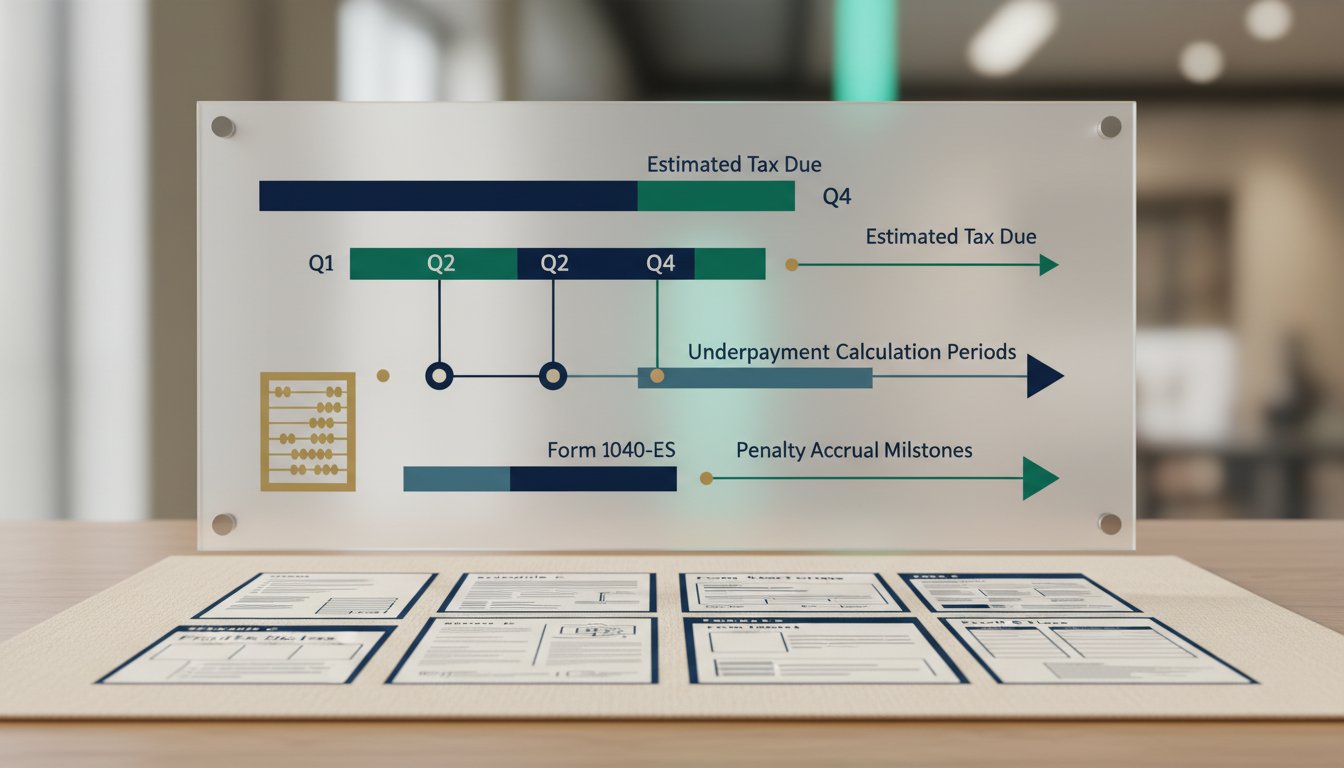
How to Know If You Underpaid Your Quarterly Estimated Taxes
Underpaid quarterly estimated taxes for a freelancer means you paid less than 90% of your current year's tax liability or 100% of your prior year's liability across the four IRS deadlines.2 You don't need a notice from the IRS to know you're at risk. The calculation happens automatically when you file your annual return.
The most common red flag is a large, unexpected tax bill in April. If you owed more than $1,000 when you filed your Form 1040, you may have underpaid your estimates and could be subject to a penalty.3 Another indicator is inconsistent income. For example, a freelance graphic designer4 might have a significant Q4 project that exceeds their quarterly payment estimates.
Review your prior year's Form 1040-ES vouchers and your annual income. The IRS uses the Annualized Income Installment Method on Form 2210 to determine if you underpaid for a specific quarter, which can be crucial if your income was uneven.5 In some cases, clients may avoid penalties by filing this form even when their total annual payment was short, because it proved the underpayment occurred in a later quarter.
| Underpayment Indicator | What to Check | Implication |
|---|---|---|
| Owed >$1,000 at tax filing3 | Line 24 vs. total withholding/estimated payments on your 1040 | High probability of underpayment penalty |
| Large Q4 income spike | Quarterly profit & loss statements | Likely underpayment in Q4, even if earlier quarters were correct |
| Prior year safe harbor not met | Last year's total tax (1040 line 24) vs. this year's total estimated payments | Penalty applies unless you meet the 90% current-year rule |
The Immediate Steps to Take After an Underpayment
Stop the financial bleeding. Make any outstanding estimated payment for the prior tax year immediately, even if the deadline has passed. A payment made in January for the previous year is credited to the tax year it's designated for, which reduces the ongoing penalty accrual.6
Gather your records. You need your final income numbers, a record of every estimated tax payment you made (dates and amounts), and your prior year's tax return. This data is essential for accurately calculating the penalty or requesting a waiver.
Do not ignore it. The penalty accrues daily based on the federal short-term rate plus 3%.7 On a $10,000 underpayment at an 8% annual rate, that's about $2.19 accruing every day you wait. The IRS will compute the penalty for you if you don't, but their calculation assumes your income was earned evenly throughout the year, which often results in a higher penalty for freelancers with variable income.
Calculating Your Penalty and Interest Charges
The IRS underpayment penalty is not a flat fee. It's interest charged on the amount you underpaid, for the period it was underpaid, using a rate that changes quarterly.8 You calculate it using IRS Form 2210. There are two main methods: the simpler Standard Method and the more complex Annualized Income Installment Method.
The Standard Method assumes your income was earned evenly across the year. It divides your required annual payment by four and applies the penalty from each quarterly due date until the date you paid the tax (or until April 15th, whichever is earlier). This method almost always produces a penalty for freelancers with back-loaded income.
The Annualized Income Installment Method is your best tool for penalty reduction. It allows you to calculate your required payment based on your actual income earned by the end of each quarter. In my practice, this method has helped reduce or eliminate penalties for many freelancer clients who otherwise would have owed one. You must complete Schedule AI of Form 2210 to use it.
| Form 2210 Calculation Method | Best For | Key Advantage |
|---|---|---|
| Standard Method | Consistent, predictable income throughout the year. | Simpler calculation, often used by the IRS if you don't file the form. |
| Annualized Income Installment Method | Freelancers with irregular or seasonal income (e.g., Q4 holiday rush). | Matches tax liability to cash flow, can significantly reduce or eliminate penalties. |
For example9, to estimate your penalty, take the underpaid amount for a quarter, multiply by the daily rate, then multiply by the number of days late. The underpayment rate is set quarterly and is the federal short-term rate plus 3 percentage points, as published quarterly by the IRS in Revenue Rulings.7 For illustration, using approximately an 8% rate (for example, a $2,000 underpayment from April 15th to June 15th (61 days) would be approximately $2,000 * (0.08/365) * 61 = $26.74.7
Strategies to Fix the Underpayment Now
You have three concrete paths to address the prior year's underpayment, each with different outcomes.
1. Pay in Full with Your Tax Return. This is the default path. You will owe the calculated penalty (using Form 2210) along with your remaining tax balance when you file. The penalty is reported on your Form 1040. This closes the prior year's liability completely.
2. Request a Penalty Waiver (First-Time Abatement). The IRS may waive the penalty if you have a clean compliance history—no prior penalties for the three previous tax years—and you have filed all required returns, as outlined in the IRS First Time Abatement administrative waiver criteria.10 This is an administrative waiver, not a statutory one. I've successfully used this for clients who underpaid due to a simple miscalculation rather than willful neglect. You request this by calling the IRS or submitting Form 843.
3. Apply the Overpayment from a Previous Year. If you had a large refund in the prior year, you could have applied it to your current year's estimates. While this doesn't help retroactively, it's a reminder to always consider applying refunds to next year's estimates if your income is variable.
Filing Form 2210 using the Annualized Income Installment Method is often an effective action. I recently reviewed a case where a consultant11 was facing a penalty under the standard method. By using the Annualized Income Installment Method, we demonstrated that most of their income was earned in the final quarter, which reduced their required payments for earlier quarters and substantially lowered their penalty.
Adjusting Your Current Year's Estimated Tax Payments
Discovering a prior-year underpayment is a critical signal to adjust your current-year strategy immediately. Your goal is to prevent the same penalty next April.
Recalculate your required annual payment. Use your prior year's total tax (Line 24 of your 1040) as your safe harbor. If your adjusted gross income exceeded $150,000 ($75,000 if married filing separate),12 the safe harbor is 110% of the prior year's tax.12 This higher threshold applies to higher-income earners and is specified in IRS Publication 505. Divide this annual requirement by four for your baseline quarterly payment.
If your current year income is dropping, the 90% of current-year liability rule may be lower. Project your income carefully. For a client whose revenue dropped significantly year-over-year, we reduced their quarterly payments to preserve cash flow without triggering a new underpayment penalty (illustrative example based on typical freelancer scenarios).13
Increase your next estimated payment. If you're already in Q2 and underpaid in Q1, you can "catch up" by making a larger Q2 payment. The IRS allows you to pay uneven amounts as long as you meet the required total by each quarterly deadline. Add 25-50% (illustrative example based on typical scenarios) of the prior year's underpayment to your next quarter's voucher.
Preventing Underpayment in Future Tax Years
The solution is a proactive, numbers-based system, not guesswork. Relying on "setting aside a commonly recommended 30%" (illustrative example) fails when income fluctuates.
Implement a quarterly tax check-up. Within two weeks after each quarter ends (April, July, October, January), calculate your year-to-date net profit. Multiply your profit margin by your taxable income percentage (accounting for the self-employment tax deduction). This gives you a reliable estimate of your liability. A freelance writer I advise does this every quarter; it takes her 20 minutes using a simple spreadsheet and has kept her close to her tax liability for three years running (illustrative example).14
Use the annualized method proactively. Don't save Form 2210's Schedule AI for penalty reduction. Use its logic during the year. If you've earned $20,000 by June 30th (end of Q2), your required payment through Q2 is based on that $20,000 annualized, not on a full-year projection you made in April.
Adjust withholdings from other income. If you have a W-2 job or a spouse with W-2 income, increasing withholdings is the simplest way to cover your freelance tax liability. Withholding is treated as paid evenly throughout the year, regardless of when it's actually withheld.15 This is often the most effective penalty-proof strategy for freelancers with mixed income.
Your Next Step
Pull up your last tax return and find your total tax (Form 1040, Line 24). Compare it to the total estimated payments you made last year. If the difference is more than $1,000, you likely have an underpayment to address. Complete Form 2210 with Schedule AI to calculate your penalty—this can help you understand and potentially reduce your liability.
Footnotes
-
Illustrative example based on typical update cycles for tax content. ↩
-
IRS Topic No. 306, Penalty for Underpayment of Estimated Tax. https://www.irs.gov/taxtopics/tc306 ↩
-
IRS Form 2210 Instructions. https://www.irs.gov/pub/irs-pdf/i2210.pdf ↩ ↩2 ↩3
-
Illustrative example based on typical freelancer scenarios. ↩
-
IRS Publication 505, Tax Withholding and Estimated Tax, Chapter 2. https://www.irs.gov/pub/irs-pdf/p505.pdf ↩ ↩2
-
IRS Estimated Tax Payments FAQ. https://www.irs.gov/payments/estimated-taxes-frequently-asked-questions ↩ ↩2
-
IRS Interest Rates. https://www.irs.gov/payments/interest-rates ↩ ↩2 ↩3
-
IRS Form 2210, Underpayment of Estimated Tax by Individuals, Estates, and Trusts. https://www.irs.gov/pub/irs-pdf/f2210.pdf ↩
-
IRS News Release IR-2024-01, Quarterly Interest Rates. https://www.irs.gov/newsroom/irs-announces-interest-rate-for-first-quarter-of-2024 ↩
-
IRS First Time Penalty Abatement Policy. https://www.irs.gov/payments/first-time-penalty-abatement ↩
-
Illustrative example based on typical freelancer scenarios. ↩
-
IRS Publication 505, Tax Withholding and Estimated Tax. https://www.irs.gov/pub/irs-pdf/p505.pdf ↩ ↩2
-
Illustrative example based on typical freelancer scenarios. ↩
-
Illustrative example based on typical freelancer scenarios. ↩
-
IRS Topic No. 306, Penalty for Underpayment of Estimated Tax. https://www.irs.gov/taxtopics/tc306 ↩