Disclaimer: This is not tax advice. Consult a licensed CPA for your specific situation.
If you drive for freelance work—client meetings, job sites, supply runs—you're entitled to deduct vehicle expenses. But here's what most freelancers don't know: you're choosing between two completely different calculation methods, and the wrong choice could cost you thousands.
The standard mileage rate vs actual expense method isn't just an accounting detail. It's a strategic decision that directly impacts how much you save. In this guide, you'll learn exactly how each method works, see real-world calculations, and walk away knowing which one will save you more money.
Understanding the Two Vehicle Deduction Methods
What Is the Standard Mileage Rate?
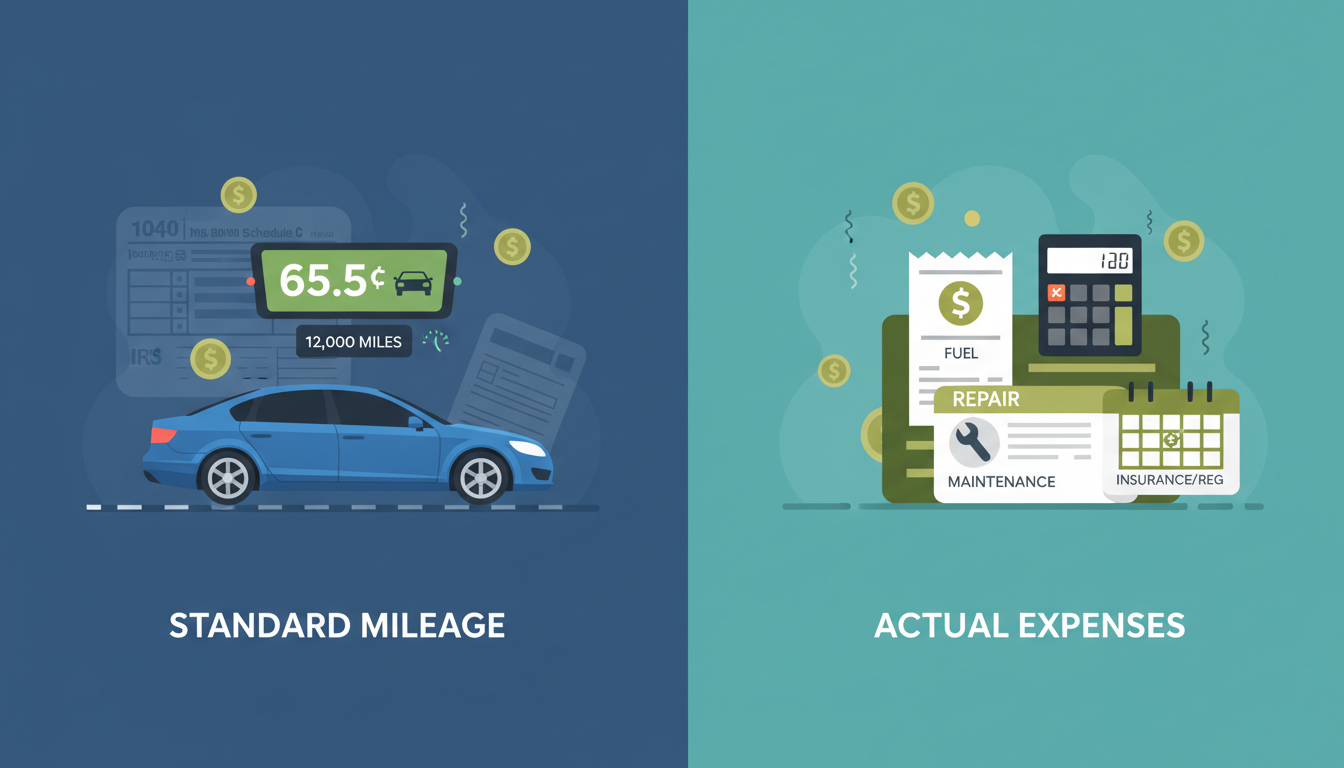
The standard mileage rate is a simplified deduction method where you multiply your total business miles by a fixed rate set by the IRS each year. For 2025, the rate is 70 cents per mile. For 2026, it's 72.5 cents per mile. For a deeper dive into the standard rate, see our IRS standard mileage rate guide.
This rate covers virtually all vehicle costs in one number:
- Gas and fuel
- Insurance
- Repairs and maintenance
- Vehicle depreciation
- Registration fees
- Tires and wear-and-tear
You don't need to track individual receipts or calculate depreciation. Just log your business miles and multiply.
What Is the Actual Expense Method?
The actual expense method requires you to track every vehicle-related cost throughout the year, then calculate the percentage attributable to business use.
Eligible expenses include:
- Gas and fuel
- Insurance premiums
- Repair and maintenance
- Vehicle depreciation
- Registration fees
- Parking and tolls
- Lease payments (if leasing)
You multiply your total expenses by your business-use percentage to get your deduction.
Step-by-Step Calculation: Which Method Saves More?
Step 1: Calculate Your Standard Mileage Deduction
Formula:
Business Miles × Standard Mileage Rate = Standard Mileage Deduction
Example: Freelancer A
- Annual business miles: 15,000
- Standard mileage rate (2025): $0.70
- Calculation: 15,000 × $0.70 = $10,500 deduction
Step 2: Calculate Your Actual Expense Deduction
Formula:
Total Vehicle Expenses × Business Use % = Actual Expense Deduction
Where:
Business Use % = Business Miles ÷ Total Miles Driven
Example: Freelancer A (continued)
- Total miles driven: 20,000
- Business miles: 15,000
- Business use percentage: 15,000 ÷ 20,000 = 75%
- Total vehicle expenses: $8,000
- Calculation: $8,000 × 0.75 = $6,000 deduction
Result: In this scenario, standard mileage saves $4,500 more.
Real-World Comparison Examples
Example 1: The Commuter Freelancer
Sarah is a freelance graphic designer who drives 12,000 business miles per year. Her total vehicle expenses are $9,600.
| Method | Calculation | Deduction |
|---|---|---|
| Standard Mileage (2025) | 12,000 × $0.70 | $8,400 |
| Actual Expense | $9,600 × 60%* | $5,760 |
*Sarah drives 20,000 total miles; 12,000 ÷ 20,000 = 60% business use.
Winner: Standard mileage — saves $2,640 more
Example 2: The High-Mileage Consultant
Marcus is a freelance IT consultant who drives 28,000 business miles annually. His vehicle is fuel-efficient, and total expenses average $0.45 per mile.
| Method | Calculation | Deduction |
|---|---|---|
| Standard Mileage (2025) | 28,000 × $0.70 | $19,600 |
| Actual Expense | $12,600 × 80%* | $10,080 |
*Marcus drives 35,000 total miles; 28,000 ÷ 35,000 = 80% business use.
Winner: Standard mileage — saves $9,520 more
Example 3: The Electric Vehicle Owner
Jennifer drives 10,000 business miles per year in her Tesla. Total expenses (insurance, electricity, maintenance) are $3,500.
| Method | Calculation | Deduction |
|---|---|---|
| Standard Mileage (2025) | 10,000 × $0.70 | $7,000 |
| Actual Expense | $3,500 × 50%* | $1,750 |
*Jennifer drives 20,000 total miles.
Winner: Standard mileage — saves $5,250 more
Example 4: When Actual Expense Wins
David drives 30,000 business miles in an older truck with high repair costs. His total expenses are $18,000.
| Method | Calculation | Deduction |
|---|---|---|
| Standard Mileage (2025) | 30,000 × $0.70 | $21,000 |
| Actual Expense | $18,000 × 75%* | $13,500 |
*David drives 40,000 total miles.
Winner: Standard mileage — still wins by $7,500
When Actual Expense Might Win
In rare cases, the actual expense method can exceed standard mileage:
- Very high vehicle costs: If your vehicle requires expensive repairs, has high insurance premiums, or depreciates significantly
- Heavy business use: When business use exceeds 85-90% of total driving
- Specialty vehicles: Work trucks or vans with high operating costs
However, even in these scenarios, standard mileage often wins because the IRS rate is designed to reflect average vehicle operating costs.
IRS Rules and Documentation Requirements
Critical Rule: Method Switching
Important: If you use the actual expense method in the first year you place a vehicle in service, you must use that method for the entire life of that vehicle. However, if you start with standard mileage, you can switch to actual expense in subsequent years.
Required Documentation
For standard mileage:
- Date of each trip
- Starting and ending locations
- Business purpose
- Miles driven
For actual expense method:
- All receipts for vehicle expenses
- Mileage log (to prove business-use percentage)
- Records showing total miles driven
The IRS requires contemporaneous records—meaning you should document trips as they happen, not reconstruct them at year-end.
How to Choose the Right Method
Use Standard Mileage When:
- You want simple, low-maintenance record-keeping
- Your vehicle has average fuel economy and operating costs
- Your business mileage is between 5,000 and 30,000 miles annually
- You don't want to track every repair receipt
Use Actual Expense When:
- You have a fuel-efficient or electric vehicle with exceptionally low operating costs
- Your business mileage exceeds 25,000 miles per year
- You already track all vehicle expenses meticulously
- Your vehicle has unusual business-related costs (specialty equipment, heavy wear)
Pro Tip: Run the Numbers Every Year
Your vehicle expenses and driving patterns change. Calculate both methods each tax year and choose the one that gives you the larger deduction.
Record-Keeping Best Practices
For Standard Mileage
- Use a mileage tracking app: MileageIQ, Stride, or QuickBooks Self-Employed automatically log trips
- Record immediately: Document miles right after each trip while details are fresh
- Capture business purpose: Note which client or project each trip relates to
For Actual Expense Method
- Keep every receipt: Gas, insurance, repairs, maintenance—everything
- Track total miles: You need both business AND personal miles to calculate your percentage
- Document start and end odometer: At minimum, record odometer at start and end of tax year
The Bottom Line: Don't Leave Money on the Table
The standard mileage rate vs actual expense method decision is one of the most impactful tax choices freelancers make. With the 2025 rate at 70 cents per mile (and 72.5 cents for 2026), standard mileage wins in most scenarios—but you should calculate both every year.
The key is accurate record-keeping from day one. Whether you choose standard mileage or actual expenses, start tracking now. Don't wait until tax season to discover you've been using the wrong method. Vehicle expenses are just one of the top deductions every 1099 contractor should know.
Prefile Check helps freelancers like you categorize expenses accurately and maximize deductions. Our AI-powered tool analyzes your spending and ensures you're taking every deduction you're entitled to—including vehicle expenses.
Calculate your vehicle deduction now and see exactly which method will save you more this tax year.
Related Articles
- Freelancer Mileage Deduction Guide: IRS Standard Rate — Detailed guide to the IRS standard mileage rate
- Home Office Deduction for Freelancers: The Complete 2026 Guide — Another major deduction for freelancers
- Top 15 Tax Deductions Every 1099 Contractor Should Know — Comprehensive deduction list including vehicle expenses
- Organize Your Freelance Expenses for Taxes — Track vehicle expenses alongside other deductions
Important Disclaimer: This article is for general informational and educational purposes only and does not constitute tax, legal, or financial advice. Nothing in this article should be relied upon as a substitute for advice from a licensed tax professional, CPA, or enrolled agent who can evaluate your specific situation. No attorney-client or CPA-client relationship is created by reading this content.
Vehicle Deduction Specific Disclaimer: The IRS standard mileage rate is set annually and may change. The 2025 rate of 70 cents per mile is based on IRS Notice 2025-5. The 2026 rate of 72.5 cents per mile is per IRS News Release IR-2024-312. Always verify current rates at IRS.gov before filing. State tax treatment of vehicle deductions varies—consult a tax professional for your state's rules. Freelancers should maintain contemporaneous records regardless of which method they choose, as the IRS requires documentation to support any vehicle deduction claimed.
Record-Keeping Reminder: Under IRS rules, you must keep records sufficient to establish the amount of your deduction. For standard mileage, this means a mileage log showing date, destination, business purpose, and miles for each trip. For actual expenses, this means receipts for all vehicle-related costs plus mileage records to calculate your business-use percentage. Failure to maintain adequate records may result in the IRS disallowing your deduction entirely in an audit.
Tax laws and IRS guidance change frequently. Always verify current rates and rules at IRS.gov before filing your tax return.